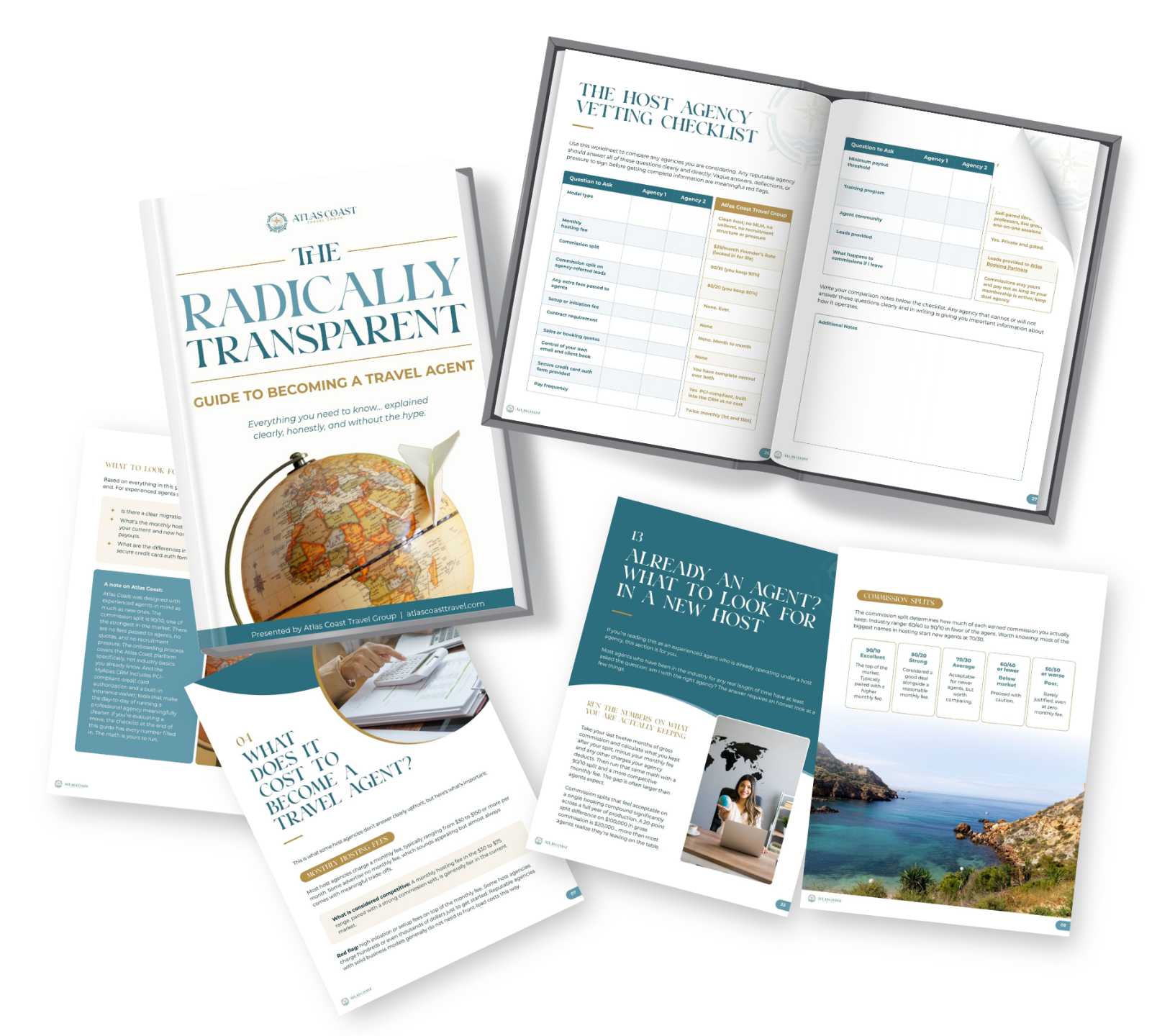
How to Choose a Host Agency: A Side-by-Side Checklist

The short answer: choose a host agency by asking every option the same 11 questions about cost, commission, payouts, training, tools, contract terms, credentials, and how money is made, then comparing the written answers side by side. The checklist is below.
Why This Choice Is Harder Than It Looks
Every host agency website says roughly the same thing: great commissions, amazing training, a supportive community. Then you sign up, and the real differences show up in the places nobody put on the homepage. A fee that comes out of your payouts. A split that only gets good after you hit a sales target. A contract that makes leaving harder than joining.
The fix is simple, and it's what I'd tell any student comparing two job offers: stop comparing marketing and start comparing answers to the same questions. Below is the exact checklist I'd use, what a good answer sounds like, and the red flags that should make you slow down.
You can use it on any host, including us. That's the point.
The Host Agency Checklist at a Glance
Ask every host you're considering the same 11 questions, in writing if you can. Email is great for this, because you'll have the answers saved when it's time to decide.
| Ask every host | A good answer | Red flag |
|---|---|---|
| What does it cost per month, per year, and to get started? | One clear number, posted publicly, with no startup or setup fee | "It depends" or a sales call before they'll tell you |
| Is anything deducted from my commission payouts? | No processing, ACH, transfer, or admin fees taken out | Fees that come out before money reaches you |
| Are the business tools included at no extra cost? | A client CRM, a PCI-compliant credit card authorization form, and an insurance waiver form, all included | Basic tools sold as add-ons after you join |
| What's the commission split, and does it ever change? | One split from day one, no tiers or sales targets | A better split "unlocked" by volume |
| What is the split applied to? | They explain non-commissionable fares and taxes without being asked | Examples that assume commission on the full trip price |
| When and how do I get paid? | Set pay dates and a low minimum that rolls forward instead of expiring | Vague timing, or small balances that disappear |
| What training is included, and who built it? | A real, structured curriculum you can see an outline of | A folder of old webinar recordings |
| How long is the contract, and how do I leave? | No long-term commitment, simple cancellation, terms you can read before you join | Notice periods, exit fees, or an agreement they won't share upfront |
| What happens to my clients and commissions if I leave? | Your clients and data are yours, and pending commission rules are written down | Claims on your clients, a ban on working with another host, or rules you only learn on the way out |
| What credentials and registrations do I book under? | CLIA and IATAN at the agency level, plus Seller of Travel registrations where required | No straight answer on accreditation |
| How does anyone earn money besides booking travel? | They don't. Income comes from your own bookings | Overrides, levels, team bonuses, or recruiting income |
Now let's walk through why each one matters.
Fees: Compare the Whole Cost, Not the Headline
Monthly fees are the easy part to compare. The trouble is everything around them. Ask about startup or setup fees, annual renewal fees, technology fees, and anything charged per booking.
Then ask the question most people skip: is anything taken out of my commission before it's paid to me? Some hosts deduct payment processing, ACH, transfer, or administrative fees from payouts, which means you're paying to receive money you already earned. Ask about each payout method by name, too, since a host can be free by direct deposit and charge for everything else. None of this shows up on a pricing page, so you have to ask.
Be careful with "free" hosting, too. A host that charges nothing per month often makes it back through a much smaller commission split. Once you're booking real volume, a bigger cut of every commission costs far more than a monthly fee would. Run the numbers on your own expected bookings before you decide which model is cheaper. Our breakdown of host agency fees walks through the common fee models side by side.
Commission Split: Ask What It's Applied To
The split is the share of each commission you keep. A 90/10 split means you keep 90% and the host keeps 10%. Simple enough, but there are three follow-up questions that change the math.
- Is it the same from day one? Some hosts start new agents on a lower split and raise it once you hit a sales target. Ask exactly what you'd keep on your first booking.
- What is it applied to? Suppliers don't pay commission on every dollar a client spends. Cruise lines, for example, don't pay on taxes, port fees, or non-commissionable fares (NCFs), the part of the fare the line excludes from commission. A good host explains this before you have to ask.
- How and when do you get paid? Ask for the pay dates, the minimum payout, and what happens to a balance under that minimum. The best answer is that it rolls forward and never expires.
For a deeper look at why the split matters more than almost anything else on this list, see why the 90/10 split matters.
Training and Support: Ask to See It
"Comprehensive training" can mean a real curriculum, or it can mean a shared drive full of recordings from three years ago. Ask what's covered, who built it, and whether you can see an outline before you join.
Then ask about the help you'll get once you're booking. Is there a real support inbox? Live sessions where you can ask questions? A community of other agents? And who answers when a booking goes sideways at 4:00 on a Friday? You don't need a manager. You do need somewhere to turn.
Tools: Ask What's Included and What Costs Extra
Some hosts keep the monthly fee low and then charge for the tools you need to run a professional business. Ask which of these come with your membership and which cost extra:
- A client CRM. A place to keep client records, trips, and commissions together, so nothing lives in scattered spreadsheets.
- A PCI-compliant credit card authorization form. PCI is the security standard for handling card data. When a client authorizes a charge, the card details belong in a secure form, not in an email or a screenshot, because a leaked card number is your problem.
- An insurance waiver form. When a client turns down travel insurance, a signed waiver documents that you offered it. If the trip goes wrong later, that record protects you.
Contract and Exit Terms: Read Them Before You Join
This is the section people skip, and it's the one that matters most if things don't work out. Ask for the independent contractor agreement before you pay anything, and read it. A host that won't share its agreement until after you join is telling you something.
Here's what to look for:
- Length and cancellation. Is there a minimum term, a notice period, or an exit fee? Can you cancel online?
- Your clients. If you leave, are your clients and client records yours to take with you?
- Pending commission. What happens to commission on trips that haven't traveled yet, or that suppliers haven't paid yet, when you leave? There's no single industry answer, so get the host's rule in writing and plan your exit timing around it.
- Restrictions. Look for non-compete or non-solicitation language and make sure you understand what it covers.
- Dual hosting. Can you sign with a new host while your old membership stays active? That overlap is how most agents switch without losing commission on trips that haven't paid out yet.
Here's the one that should stop you cold. Some hosts punish agents for leaving. They ban dual hosting, then threaten to terminate you and keep the commissions still in your pipeline if you sign with another host. That's a huge red flag. A host that's confident in what it offers doesn't need to hold your money over your head to keep you.
If you're switching hosts, remember that bookings you already made stay with your current host. With most hosts, it makes sense to keep that membership active until those bookings pay out. Our host agency contract guide goes clause by clause.
Credentials and Seller of Travel Registrations
When you work under a host, you book under the host's agency credentials, not your own. Ask which ones it holds. CLIA is what cruise lines recognize, and IATAN is what most hotels and other suppliers verify. Our CLIA and IATAN explainer sorts out which is which.
Ask about state registrations too. California, Florida, Hawaii, and Washington require Seller of Travel registration, and the rules follow where your client lives. A host should be able to tell you which states it's registered in and whether you have anything to file yourself. Here's the rundown on Seller of Travel laws by state.
MLM Red Flags to Watch For
Plenty of businesses in this space are built more around recruiting than around booking travel. Here's how to spot one:
- You earn money from agents you bring in, through overrides, levels, ranks, or team bonuses
- The pitch talks more about "building a team" than about booking trips
- Heavy "mentor" or "upline" language
- Income claims built on the top earners instead of the typical agent
- Pressure to buy in now, before you've had time to read anything
A legitimate host makes its money from memberships, its share of commissions, or both, and you make yours from your own bookings. If you're not sure, our 3-question MLM test and our guide to reading host agency income claims will help.
How to Run the Comparison
Here's the process I'd follow:
- Pick two or three hosts. More than that and the details blur together.
- Copy the 11 questions above into an email and send the same list to each one. Compare written answers, not sales calls.
- Read each contract before you pay. If something in it surprises you, ask about it.
- Check reviews on sites the host doesn't control, like Host Agency Reviews, the Better Business Bureau, and Trustpilot. Look at how the host responds to criticism, not just the star rating.
- Run your own numbers. Estimate what you expect to book in a year and calculate what you'd actually keep with each host after every fee and split.
If one host answers everything clearly and another keeps steering you to a call, that difference tells you most of what you need to know.
We'd be a little hypocritical if we wrote this and didn't answer it ourselves, so here goes. Membership is $49 a month, locked in for as long as you stay a continuous member, or $568 a year. There are no startup fees, and nothing is deducted from your payouts, including ACH or processing fees. You keep 90% of every commission from day one, with no tiers. Payouts go out on the 1st and 15th, and balances under $25 roll forward and never expire. There's no long-term contract, you can cancel online, and your clients are yours if you leave. We're non-exclusive, too, so if you're switching hosts, you can keep your old membership active until your pending commissions clear. Our full agreement is public at atlascoasttravel.com/ita, so you can read it before you join.
Your MyAtlas account, our client CRM, is included, along with a secure credit card authorization form and insurance waiver forms. You book under our CLIA and IATAN credentials and our Seller of Travel registrations in California, Florida, Hawaii, and Washington. And we're not an MLM. There are no levels, no overrides, and no recruiting income. The only referral payment is a one-time bonus when someone you refer joins and stays active for six months.
Hold us to the same standard as everyone else. Read our independent reviews, grab the free guide, save a seat at the free webinar on becoming a travel agent, see why agents choose Atlas, and join when you're ready.
FAQ
What should I look for in a host agency?
Compare the full cost (monthly, startup, and anything deducted from payouts), the commission split and what it's applied to, how and when you get paid, the training and support, the contract and exit terms, which business tools are included, the credentials and Seller of Travel registrations you'll book under, and whether anyone earns money from recruiting. Ask every host the same questions in writing.
Is a host agency with no monthly fee a better deal?
Not always. Hosts with no monthly fee often keep a much larger share of each commission. Once you're booking steadily, that bigger cut can cost far more than a monthly fee. Estimate your yearly bookings and calculate what you'd keep with each host.
How can I tell if a host agency is an MLM?
Look at how money is made. If agents earn from people they recruit through overrides, levels, ranks, or team bonuses, it's built like an MLM. A legitimate host's agents earn from their own bookings.
Can I switch host agencies later?
Yes. Bookings you've already made stay with your current host, so with most hosts it makes sense to keep that membership active until those bookings pay out. Check the contract for notice periods, exit fees, and the rules on pending commission before you join any host.
Should I read the host agency contract before joining?
Yes. Ask for the independent contractor agreement before you pay, and read the sections on cancellation, your clients, pending commission, and any non-compete or non-solicitation terms. A host that won't share its agreement upfront is a host to question.
Sources: CLIA; IATAN; Host Agency Reviews. Last reviewed 2026.
Want to know all the info about becoming a travel agent?