Can You Become a Travel Agent Just to Book Your Own Travel? Here's the Real Math
Can you become a travel agent just to book your own travel? Yes. Plenty of people do, and it's one of the most common reasons people start looking into this in the first place.
But "can you" isn't really the question. The real question is whether it actually pays off, or whether you're just paying a monthly fee to feel fancy. So I did what any business professor would do. I ran the numbers.
- Yes, you can become a travel agent and earn commission on your own trips. With a lot of suppliers, especially cruise lines, that's allowed and normal.
- "Two trips a year covers your costs" is mostly true. At our agents' real average, two trips gets you to about break-even. Three puts you ahead.
- Your commission split matters more than almost anything else. Keeping 90% versus 70% is the difference between breaking even and not.
- The perks are real (ship tours, training rewards, agent rates), but the big ones usually go to agents who are actively booking.
- Pick a host with no quotas if you're booking mostly for yourself. Some hosts will pressure you. We don't.
- How travel agents make money on their own trips
- Does "two trips a year" really cover your host fees?
- Why your commission split matters more than the monthly fee
- The honest downsides (and who this isn't for)
- The perks of being a travel agent (and who actually gets them)
- Pick a host that won't pressure you to produce
- The best part: people who just love travel
- So, should you become a travel agent to book your own travel?
- FAQ
How Do Travel Agents Make Money on Their Own Trips?
Here's the part most people get wrong. Being a travel agent doesn't mean you get a magic discount at checkout.
What you get is commission. When you book a cruise or a resort through your agency's credentials, the supplier pays a commission on that booking. And yes, that includes trips you take yourself, with most cruise lines and plenty of resorts. You pay for your trip like normal. Then the commission comes back to you, usually after you travel.
On cruises, commission typically runs 12 to 16% of the base fare. Taxes and port fees aren't commissionable, so in practice it works out to around 10% of what you actually spend. Hold onto that 10% number. It's about to matter.
Does "Two Trips a Year" Really Cover Your Host Fees?
You've probably heard this one: "Just two trips a year and your host fees are covered!" It sounds like a sales line, so let's check it.
The industry number. Host Agency Reviews is basically the industry's go-to research source on host agencies. Their Hosted Advisor Report found the average sale per booking was $4,375. Using that same general rule of about 10%, HAR estimates about $438 in commission per booking.
Our real number. I wanted to see if that held up with our own agents, so we pulled the data. Across more than 2,000 cruise, vacation package, and all-inclusive bookings our agents logged in our first few months, the average commission was $312 per booking. And where agents recorded both the trip price and the commission, the commission came out to almost exactly 10% of the sale.
So HAR's 10% assumption checks out. Our agents' trips are just a little smaller than the industry average, and that makes sense. Many of our agents are brand new to the industry, so they're booking their own trips and their first few clients, not big-ticket groups yet. Our number also only counts the commission on the cruise fare or the room itself. Add-ons like travel insurance, excursions, and transfers get logged separately, which keeps our average lower too. I'm going to use our $312 number, because I'd rather show you the conservative version.
The cost side. Atlas Coast is $49 a month, or $568 a year on the annual plan. And you keep 90% of your commission.
| Commission per trip | You keep (90%) | Two trips a year | Three trips a year |
|---|---|---|---|
| $312 (our agents' average) | $281 | $562 | $842 |
| $438 (HAR industry estimate) | $394 | $788 | $1,183 |
Here's what that means against a $568 year:
- Two trips at our average: $562. That covers everything but about $6. Basically a wash.
- Two trips at the industry average: $788. That's the year covered with about $220 left over.
- Three trips at our average: $842. You're $274 ahead.
So is "two trips a year" true? Honestly, it's close. Two gets you to break-even, three gets you paid, and that's just your own vacations. Book one trip for your parents or your best friend's family and the math gets even better.
And if you tend to travel big (suites, luxury cruise lines, longer or more expensive trips), one trip can cover your entire year on its own. On Viking bookings, for example, our agents averaged about $1,686 in commission per booking. At 90%, that's roughly $1,517 back to you, which is more than two and a half years of membership.
One more thing that keeps this math clean: at Atlas Coast, $49 a month is literally it. There are no startup fees, no renewal fees, no transaction or processing fees taken out of your commission, and no fees to access supplier systems or training. No hidden fees. The only outside cost some agents run into is a small state filing if you book for Florida residents, and that goes to the state, not to us.
Why Your Commission Split Matters More Than the Monthly Fee
Okay, this is the part I really want you to read, because it's where people get burned.
Your commission split is how the commission gets divided between you and your host agency. At a 90/10 split, you keep 90% and the host keeps 10%. According to Host Agency Reviews, hosted agent splits range anywhere from 50% to 100%. That's a huge range, and it changes the math completely.
Here's the same two trips a year ($624 in total commission at our $312 average) under different splits:
| Commission split | You keep on two trips | You keep on 10 trips |
|---|---|---|
| 90/10 (Atlas Coast) | $562 | $2,808 |
| 80/20 | $499 | $2,496 |
| 70/30 | $437 | $2,184 |
| 50/50 | $312 | $1,560 |
See the problem? At 70/30, two trips leaves you about $130 short of covering a $568 year. At 90/10, you're basically even. Same trips, same commission, totally different outcome.
And it gets bigger the more you book. At 10 trips a year, the gap between 90/10 and 70/30 is $624. That's real money going to your host instead of you.
This is also why "free" hosting isn't always free. A host that charges nothing per month often makes it up by taking a much bigger cut of your commission, sometimes 30 to 50%. On the flip side, some hosts offer 100% splits but charge higher fees. Neither is automatically good or bad. You just have to run the math for how much you'll actually book.
That's why we built Atlas Coast with a 90/10 split for every agent. When you're booking a handful of trips a year, that extra 10 to 20% is often the whole difference between this paying for itself and not. We go deeper on this in why the 90/10 split matters.
The Honest Downsides (and Who This Isn't For)
I'd rather you hear this from me now than figure it out in month three.
- If you travel once a year, it probably won't pay off. The math just doesn't work on one trip. That's okay. It's not for everyone.
- Averages are averages. A week-long family cruise can pay several times our $312 average. But hotel stays, tours, and activities booked on their own averaged about $50 each for our agents. Smaller trips mean you'll need more of them.
- Commission rules on your own travel vary. Most cruise lines pay it, but every supplier sets its own rules, and you follow their process.
- The money comes later. Commission is usually paid after you travel, not when you book. So you're paying for your trip up front.
- Agent rates aren't always cheaper. Sometimes you'll find a better price as an agent. Sometimes you won't. The commission is what reliably brings your cost down.
- This is a real business, not a discount club. When you book, even for yourself, you're the agent of record and you're responsible for that booking. You'll also complete training before you can book. That's exactly what makes the commission legitimate.
The Perks of Being a Travel Agent (and Who Actually Gets Them)
Commission is the part you can put in a spreadsheet. But honestly? The perks are what make this fun. Here's what's real, and who usually gets it.
You actually learn how travel works. Cruise pricing, resort categories, travel insurance, why one cabin costs more than the one next to it. Atlas Coast members get our full training library, and most suppliers offer free, self-paced agent training of their own.
Ship tours and site inspections. Cruise lines invite agents to tour ships in port, and resorts host site inspections so you can see the property in person. Many are free or low cost. Being able to say "I've stood in that cabin" is a game changer.
FAM trips. These are heavily discounted, and sometimes free, trips suppliers offer so agents can experience the product. They're real! But they take an application, and suppliers usually want to see an active booking history. In practice, they mostly go to agents who are booking consistently.
Travel agent rates and friends and family rates. Lots of hotel brands, cruise lines, and resorts offer reduced rates for agents' own travel. Marriott, for example, has a standard travel agent rate, plus a deeper rate you unlock by finishing its free training.
Rewards for doing supplier training. Many cruise lines run agent loyalty programs with perks like points, onboard credit, upgrades, or complimentary Wi-Fi on your sailing. Most of those are tied to completing that cruise line's own agent training.
One honest caveat. Almost every perk on this list comes with the supplier's requirements attached, not ours. The deepest perks go to agents the industry sees as working agents. If the perks are part of what draws you in, you're in good company. If they're the whole plan, this probably isn't the right fit.
Pick a Host That Won't Pressure You to Produce
If you're mostly booking your own trips, the host agency you choose matters a lot. A host agency is the company that holds the industry credentials, supplier relationships, and booking tools you work under as an independent agent.
At Atlas Coast, there's no quota and no minimum booking requirement. Your $49 a month is the same whether you book one trip or 50. Plenty of our members mostly book their own travel and their family's, and that's genuinely welcome here.
Not every host works that way. Some set annual sales minimums or charge extra if you don't book enough. Add a low commission split on top of that, and someone booking two or three trips a year can end up paying more than they earn.
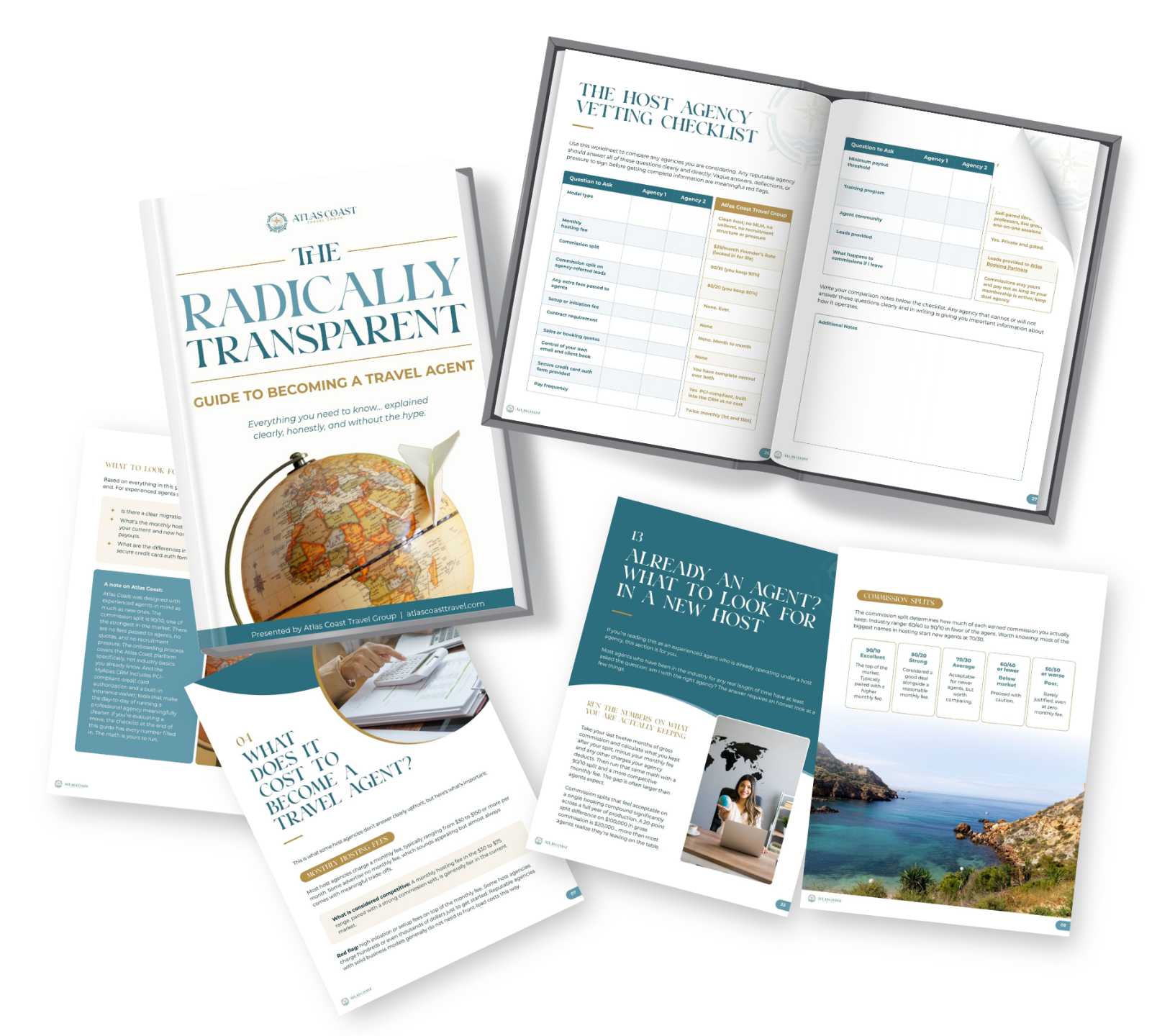
So before you pick any host, including us, compare the fees, the commission split, the contract terms, and what happens if you don't book much. We put all of that into a free guide, The Radically Transparent Guide to Becoming a Travel Agent. It includes a Host Agency Vetting Checklist so you can compare up to three agencies side by side.
The Best Part: People Who Just Love Travel
This is the part that never shows up on a commission statement. Our agent community is full of cruisers, resort lovers, road trippers, and brand-new agents who all have one thing in common. They love travel and they love talking about it.
Some are building full-time businesses. Others mostly book their own trips and a few for friends. Inside the community, they swap ship reviews, ask questions, celebrate first bookings, and help each other figure things out. We also host an annual conference built just for our agents. If you're the person your friends text when they're planning a trip, you'll fit right in.
So, Should You Become a Travel Agent to Book Your Own Travel?
If you travel two or three times a year and you're willing to book those trips the right way, the math says yes. Especially with a strong commission split. Two trips at our agents' average gets you to about break-even, and every trip after that puts money back in your pocket. Add the training, the industry access, and a community of people who get your travel obsession, and it's a lot more than a line item.
Grab the free Radically Transparent Guide, run your own numbers with the vetting checklist, and read our FAQs. When you're ready, you can join Atlas Coast here.
FAQ
Can I become a travel agent just to book my own travel?
Yes. Many people start that way, and at Atlas Coast there's no quota or minimum. You're still the agent of record on every booking, so you'll complete training and book through the proper channels.
Do travel agents get commission on their own trips?
Often, yes. Most cruise lines and many resorts pay agents commission on their own bookings, but each supplier sets its own rules.
How many trips a year do I need to book for it to be worth it?
At our agents' average of $312 in commission per booking and a 90/10 split, two trips covers nearly a full year of membership and three puts you ahead. Bigger trips get you there faster.
What's a good commission split for a travel agent?
Hosted splits range from 50% to 100%. If you're booking a few trips a year, a split like 90/10 makes a big difference. Just compare it alongside the monthly fees and any production minimums.
Is Atlas Coast an MLM?
No. There are no downlines, no recruiting requirements, and no override commissions. Your income comes from commission on the travel you book.
Sources: Host Agency Reviews, How Much Does a Travel Agent Make per Booking?; Atlas Coast booking data (cruise, vacation package, and all-inclusive commissions logged by our agents from July 6 to October 20, 2026); Atlas Coast FAQs.
Fla. Seller of Travel Ref. No. ST46588
Want to know all the info about becoming a travel agent?