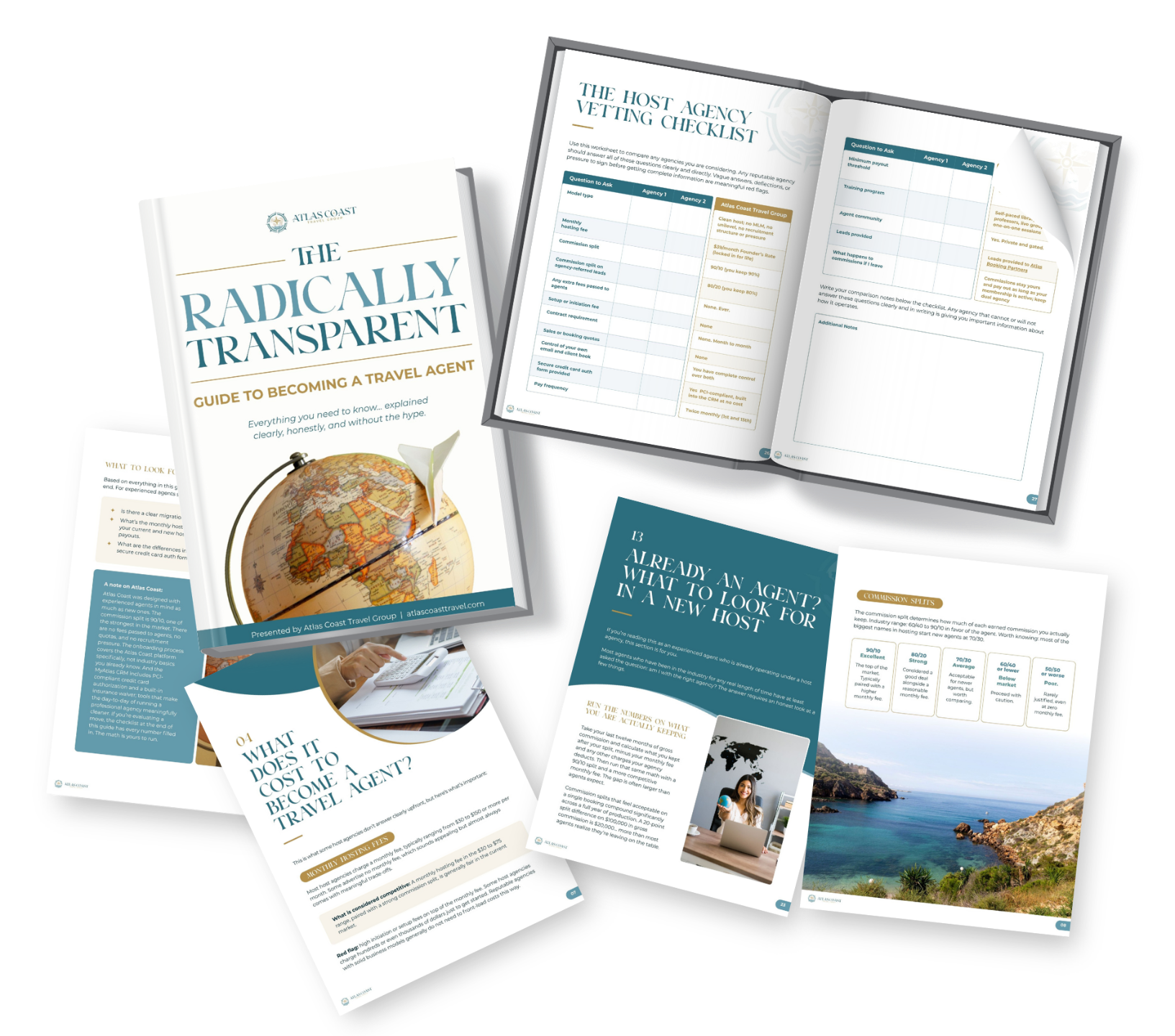
What to Look for in a Host Agency Contract

- The contract nobody reads
- Client ownership: the most important clause
- Commission split and fee structure
- Payment schedule and minimum thresholds
- Exit terms and cancellation
- What happens to unpaid commissions when you leave
- Non-solicitation and non-compete clauses
- Liability and errors and omissions
- MLM structure and recruiting income
- Transparency as a starting signal
- FAQ
The Contract Nobody Reads
I'll be blunt, because I've been around this industry long enough to watch it happen over and over: most travel agents never read their host agency agreement before they join. They glance at the commission split, maybe skim the fees, and sign.
Then six months in, they find out they can't take their client list with them if they leave. Or that the email address every client has been writing to belongs to the agency, so when they go, they leave their own inbox and all that history behind. Or that there's a non-solicitation clause stopping them from contacting clients they personally brought in, for two years after they go.
None of these are rare edge cases. They're real clauses in real host agency contracts, and if you didn't read the thing before you signed it, you don't get to be surprised later.
So I'll walk you through the clauses that actually matter. Some of it's dry. Read it anyway.
Client Ownership: The Most Important Clause
Before you look at anything else, ask one question: who owns the clients?
Say you bring a client in, book ten trips for them over three years, and then decide to leave. Can you take that relationship with you? Can you tell them you're moving and keep serving them? Or does the agency claim that client as theirs and bar you from contacting them once you're gone?
The answer swings wildly from one host to the next. Some spell out that your clients are yours and you can take them anywhere. Others treat every client as the agency's property and tie your hands the moment you leave.
This isn't a small detail. Your client relationships are your business. Losing them when you switch hosts is losing the whole thing.
And it goes further than the client list. Some host agencies give you an email address on their domain and keep ownership of it. So the address your clients have written to for years, along with the whole conversation history, stays with the agency when you leave, not with you. Same story with a phone number or a CRM login they control. Before you sign, get a straight answer on what's actually yours to keep: your client list, your email address, your contact history, your booking records. If the answer is "none of it," you're not building a business you own. You're renting one.
Read this clause. If it's not crystal clear, get the answer in writing before you sign.
Commission Split and Fee Structure
Look at the total cost of affiliating, not just the headline split.
Commission split. Your cut of what you earn. A 90/10 split means you keep 90 percent; a 70/30 split means you keep 70. On $100,000 in gross commissions a year, that gap is $20,000 in your pocket instead of theirs. We break this down in why the 90/10 split matters.
Monthly fees. A lot of hosts charge a monthly membership fee on top of the split, usually $30 to $100. Know exactly what that fee buys you. (More in host agency fees explained.)
Annual or setup fees. Some charge an upfront or yearly fee. Ask if it's refundable if you leave within a certain window.
Override commissions. Some take an extra cut on top of the split for certain supplier bookings. Read the contract for any mention of overrides or extra deductions.
The math. (Monthly fee x 12) + (your gross annual commissions x the host's split percentage) = what affiliating actually costs you for the year. Run it against what you expect to earn and see if the model makes sense for you.
Payment Schedule and Minimum Thresholds
How often do commissions get paid out, and is there a minimum balance before a payout triggers?
Some hosts pay monthly, some twice a month, some quarterly. When you're new and still building volume, how often you get paid has a real effect on your cash flow.
Most hosts set a minimum payout, usually $25 to $50, and anything under that rolls to the next cycle. Make sure those rolled-over balances don't expire, and that you get them in full if you ever close your account.
Exit Terms and Cancellation
Can you cancel anytime, or are you locked into a minimum commitment?
Some hosts are month-to-month with no lock-in. Others hold you to six months, a year, or more. Some charge a fee if you leave early.
Then there's the notice period before a cancellation actually takes effect. That one matters most if you're switching hosts, because you need to know the gap between giving notice and getting set up somewhere new.
Also check what happens to your supplier portal access once you give notice. Some hosts leave it on through the end of your paid period; others cut it off the day you give notice. Both are defensible, but you should know which one you're agreeing to.
What Happens to Unpaid Commissions When You Leave
This is the clause that catches agents off guard most often.
When you leave, you've almost certainly got bookings on the books for trips that haven't happened yet. The supplier won't pay those commissions until after the travel date. So if you're no longer with the host by then, what happens to that money?
Some hosts spell out that you get paid on bookings you made before leaving, whenever the money lands. Some keep anything that comes in after you're gone. And some leave it vague enough to end up in a dispute.
Read this one carefully. If it's vague, ask for the answer in writing and save it before you sign.
Non-Solicitation and Non-Compete Clauses
Non-solicitation clauses stop you from poaching the host's other agents after you leave. That's usually fair, and courts tend to enforce it.
Non-compete clauses that bar you from working as a travel agent at all are a lot more aggressive, and whether they hold up depends heavily on your state. Some states, California being the clearest, sharply limit non-competes for independent contractors.
The ones to really watch are client non-solicitation clauses. If you're barred from contacting clients you found and served yourself, that runs straight into the client-ownership question from earlier. Pair an agency-friendly ownership clause with a no-contact clause and you're effectively locked in for good if you want to keep your book of business.
Know what you're signing.
Liability and Errors and Omissions
Does the host carry errors and omissions (E&O) insurance that covers its agents? If so, what are the limits, and what's actually covered?
If they don't cover you, do they require you to carry your own? And if they do, what's the minimum?
E&O isn't a technicality. If a client loses money because of a mistake you made and decides to sue, an agent without coverage is personally on the hook. That's a real risk, not a hypothetical one. Here's what E&O insurance covers and why you need it.
MLM Structure and Recruiting Income
We get into this in our post on whether a travel agency is an MLM, but here's the short version: check whether the contract gives you ongoing income from agents you recruit. Is there a cascading structure? Do you earn anything off your recruits' bookings or fees beyond a one-time bonus?
If you spot words like "overrides," "team commissions," "downline," or percentages that flow up through levels from the agents you bring in, ask hard questions before you sign.
An explicit anti-MLM clause in the contract is a good sign. It means the agency thought about this and put a clean structure in writing.
Transparency as a Starting Signal
Here's the simplest test you can run before you read a single clause:
Will they show you the contract before you pay anything?
If a host won't show you the agreement until after you've paid and committed, they're making a deliberate choice about what you get to know beforehand. That choice tells you a lot about how they handle transparency everywhere else.
A host that puts it all in front of you upfront, the exact split, the fee, the exit terms, the client-ownership language, the anti-MLM clause, is running on a different philosophy. They're fine with you seeing everything because they think the terms are fair.
I researched 27 host agencies while building Atlas Coast. Not one published its full agent agreement before making you sign up or sit through a sales call. Not one.
You can read our full Independent Travel Agent agreement at atlascoasttravel.com/ita before you sign up or pay anything. The split is 90/10, the fee is $49 a month, and we pay on the 1st and 15th. Client ownership and exit terms are spelled out, not buried. As far as we could tell from researching 27 competitors, we're the only host that works this way. Want the bigger picture first? Grab the free guide, watch our free agent webinar, and join Atlas Coast when you're ready.
FAQ
What's the most important clause in a host agency contract?
Client ownership. Who owns the clients you bring in and build up? That single answer decides whether your business is actually yours to take with you, or whether it really belongs to the agency.
Can I negotiate a host agency contract?
With bigger, established agencies there's usually not much give on the standard terms. But asking questions and getting written clarification on anything vague is always fair game. A host that won't explain its own contract isn't much of a partner.
What's a typical commission split with a host agency?
They run from 70/30 to 90/10, and the competitive ones keep pushing the agent's share higher. If a split is below 80/20, take a hard look at what the host gives you in return for that bigger cut.
Are there host agencies with no monthly fees?
Yes. Some run on the split alone with no monthly fee. Whether that's better for you comes down to volume. When you're booking a little, no-fee usually costs less. When you're booking a lot, the split percentage matters more than the fee.
What happens to my bookings if a host agency goes out of business?
Your bookings live with the suppliers, so the host going under doesn't undo them. The risk is any commission that's been collected but not yet passed on to you. That's a good reason to pick a host with a track record and stable finances.
Is it legal for a host agency to claim ownership of clients I brought to them?
Yes, a contract can include client-ownership clauses, and how enforceable they are depends on your state and the situation. Reading and understanding them is on you. If the terms don't work for you, the time to push back or walk is before you sign, not after.
Sources: Host Agency Reviews contract analysis; ASTA independent contractor guidance; Atlas Coast competitive ITA research, May 2026.
Want to know all the info about becoming a travel agent?