CLIA Cards Explained: What Travel Agents Need to Know

- The credential confusion that trips up new agents
- What a CLIA number actually is
- Do you need your own CLIA number?
- CLIA vs. IATAN on the agency side
- Your individual CLIA membership, and what it's really for
- The EMBARC card (the "CLIA card" people mean)
- The personal IATAN card is a different animal
- Before you buy: timing, dues, and refunds
- Switching hosts with a membership you already have
- The simple version
- FAQ
The Credential Confusion That Trips Up New Agents
Picture this. You get to a hotel on a travel-advisor rate, hand over the CLIA number you use to book cruises, and the front desk tells you it isn't enough to verify you for the discount. The number's valid. Your agency's legitimate. But the desk is trying to confirm that you, the individual advisor standing there, qualify for the rate, and the number you handed over identifies the agency behind your bookings, not you.
That's the confusion in a nutshell. Agents hear CLIA number, CLIA card, IATAN number, and IATAN card tossed around as if they all prove the same thing. Some identify the agency. Some identify you. And one of them you can't even apply for until you've done real sales.
Here's the simple lens that sorts it out: agency credentials identify the business that owns the supplier relationship and gets paid the commission. Personal credentials identify you as an individual travel professional, for recognition, education, and supplier perks. Keep those two buckets separate and the alphabet soup untangles fast. Let's walk through each one.
Prefer to watch? Here's the short version.
What a CLIA Number Actually Is
CLIA stands for Cruise Lines International Association. It's the cruise industry's main trade association, and its Travel Agency Membership includes an industry ID number that agencies use to book directly with CLIA cruise line members and selected suppliers. That number is an agency booking credential. It's how cruise lines recognize the agency as a real, accredited booking entity, the kind that qualifies for professional commission rates instead of consumer pricing.
Atlas Coast holds its own CLIA Travel Agency Membership, so when you book a cruise under Atlas Coast, that's the credential your booking runs under. The supplier recognizes Atlas as the agency of record, and Atlas handles the commission after the supplier pays it. You don't have to go find that number or set it up. It's already there.
Here's the key thing, and it's the hotel problem from a second ago: the agency CLIA number belongs to the business. It doesn't arrive as a photo ID with the name of every advisor authorized to book under it. So when a front desk needs proof that you personally qualify for an industry rate, the agency number doesn't answer that question.
Do You Need Your Own CLIA Number?
No. This is the single most common CLIA question, and the answer is that you don't need your own CLIA number to book.
The agency membership is the booking credential, and it belongs to the agency, not to you individually. When you register with cruise lines, book trips, and earn commissions under a host agency, everything flows through the agency's CLIA number. Under Atlas Coast, you have full booking access from day one, with nothing to purchase on your own to get started.
The alternative, going fully independent, means buying your own CLIA agency membership, which is a different and much more expensive tier than an individual one, plus handling your own state Seller of Travel registrations, back-office systems, and supplier relationships from scratch. For most agents, booking under a host's agency credential is the whole point. It's the infrastructure you'd otherwise spend years and real money building, which is the real reason most travel agents work under a host agency.
CLIA vs. IATAN on the Agency Side
CLIA isn't the only agency credential in play, and this is where a lot of the mix-up starts. IATAN, the International Airlines Travel Agent Network, issues the other major agency accreditation. Once a travel business is accredited, it receives an eight-digit IATA code that suppliers use for identification, reservations, and commission distribution. IATAN's reach is broad: hotels, resorts, cruise lines, car rental companies, theme parks, and rail all recognize it.
In practice, cruise lines lean on the agency's CLIA number, while hotels and most non-cruise suppliers verify the agency through its IATAN number. Both belong to the agency, not to you. Atlas Coast holds its own IATAN accreditation right alongside its CLIA membership, so depending on what you're booking, a supplier might ask for one or the other, and either way you're providing the agency's credential, never a personal one.
People sometimes call IATAN the land-and-air version of CLIA. That's a little too loose, but the takeaway holds: two agency credentials, both held by your host, covering cruise and non-cruise suppliers. Neither one, on its own, proves that you personally qualify for an advisor perk. That's what the personal credentials are for, and that's where we go next.
Your Individual CLIA Membership, and What It's Really For
So where does a personal CLIA membership come in? CLIA also offers an Individual Agent Membership, or IAM, that agents can buy for themselves. Here's the point that clears up half the confusion: an IAM is not a booking credential. It doesn't give you a separate booking number, and it doesn't change how your commissions work.
What it does give you is recognition, education, and perks. It includes the EMBARC ID (more on that next), access to CLIA's professional development and certifications like the Accredited Cruise Counselor, and eligibility for supplier benefits like FAM trips (short for familiarization) and ship inspections, where cruise lines and resorts host advisors to experience a product firsthand. A listing in CLIA's public Agent Finder directory is available too, as an optional add-on with its own small annual fee.
A concrete example of why agents buy in: hotel programs built for travel advisors. Marriott's Fam-Tastic rates, for instance, give qualified advisors deeply discounted familiarization stays at Marriott hotels so they can experience a property before recommending it. A recognized personal credential like your individual CLIA is one of the accreditations Marriott accepts, though it layers its own Hotel Excellence training on top, so this is a good reminder that each program sets its own rules. Read what the offer actually requires rather than assuming any one card unlocks every rate.
CLIA sets the annual dues and adjusts them from time to time, so instead of printing a figure that goes stale, we'll point you to the source: check current pricing at cruising.org when you're ready. One nice bit of transparency worth knowing if you're weighing hosts: Atlas Coast reimburses the CLIA individual membership fee for its Booking Partners.
The EMBARC Card (the "CLIA Card" People Mean)
When someone says CLIA card, this is almost always what they mean. The EMBARC ID (formerly called the CLIA card) is CLIA's official personal credential, and it comes with an individual membership. You'd show it at FAM trips, supplier events, and industry training to identify yourself as a working travel professional rather than a consumer.
It's an identification and perks credential, not a booking credential. If a hotel front desk or a cruise line ever asks to see your CLIA card, this is what they're asking for, and it's separate from the agency CLIA number your bookings actually run under. Same four letters, two very different things. And holding it doesn't automatically guarantee every hotel rate or FAM trip, because each supplier decides who qualifies and may want additional proof, so always read the offer.
The Personal IATAN Card Is a Different Animal
CLIA's individual membership is something you can simply buy, once your agency is a CLIA member. The personal IATAN ID card is not, and this trips people up constantly.
The IATAN card is issued in your name and recognized by suppliers as proof of your professional status, with its own benefits platform of hotel and training discounts. But you can't just purchase it at the start of your career. It carries real production requirements: you have to be actively selling travel, meeting a minimum number of weekly hours and a minimum amount earned in salary or commissions over the prior year, and your agency has to be able to verify that you show up in its commission or payroll records. IATAN publishes the current thresholds on its ID card conditions page.
There's also a specific order of operations, and it's the part most people get backwards the first time. You don't start the application. Your agency does. The agency registers you on its personnel list first, and only then does IATAN email you an invitation to apply for the card, assuming you meet the requirements. You can't skip to the front of that line. At Atlas Coast, this starts with agent support: we confirm you appear to meet the requirements, register you through the agency account, and then you watch for the IATAN email. One small quirk worth knowing: the printed card gets mailed to the agency address, not to your home.
Before You Buy: Timing, Dues, and Refunds
Two things about a personal CLIA membership can quietly cost you money if you don't know them going in.
First, the timing. CLIA's individual membership runs on the calendar year, so it expires December 31 no matter when you buy it. The dues are the same whether you join in January or October, but joining early gets you a full 12 months and joining late gets you only a few weeks for the same money. So don't rush to buy every credential in your first week. If you're heading into CLIA courses, ship inspections, events, or advisor travel offers soon, you'll get value fast. If you're still working through basic host training in the fall, waiting until January is often the smarter move.
Second, the dues aren't refundable. An individual membership isn't a simple checkout. You apply through your own CLIA account and name your host agency as your affiliation, and the application then goes to that agency to approve, because CLIA lets each member agency decide which of its agents it appoints. The catch is the timing again. CLIA collects your dues the moment you apply, before the agency ever sees the application, and if you can't be approved, CLIA doesn't refund them.
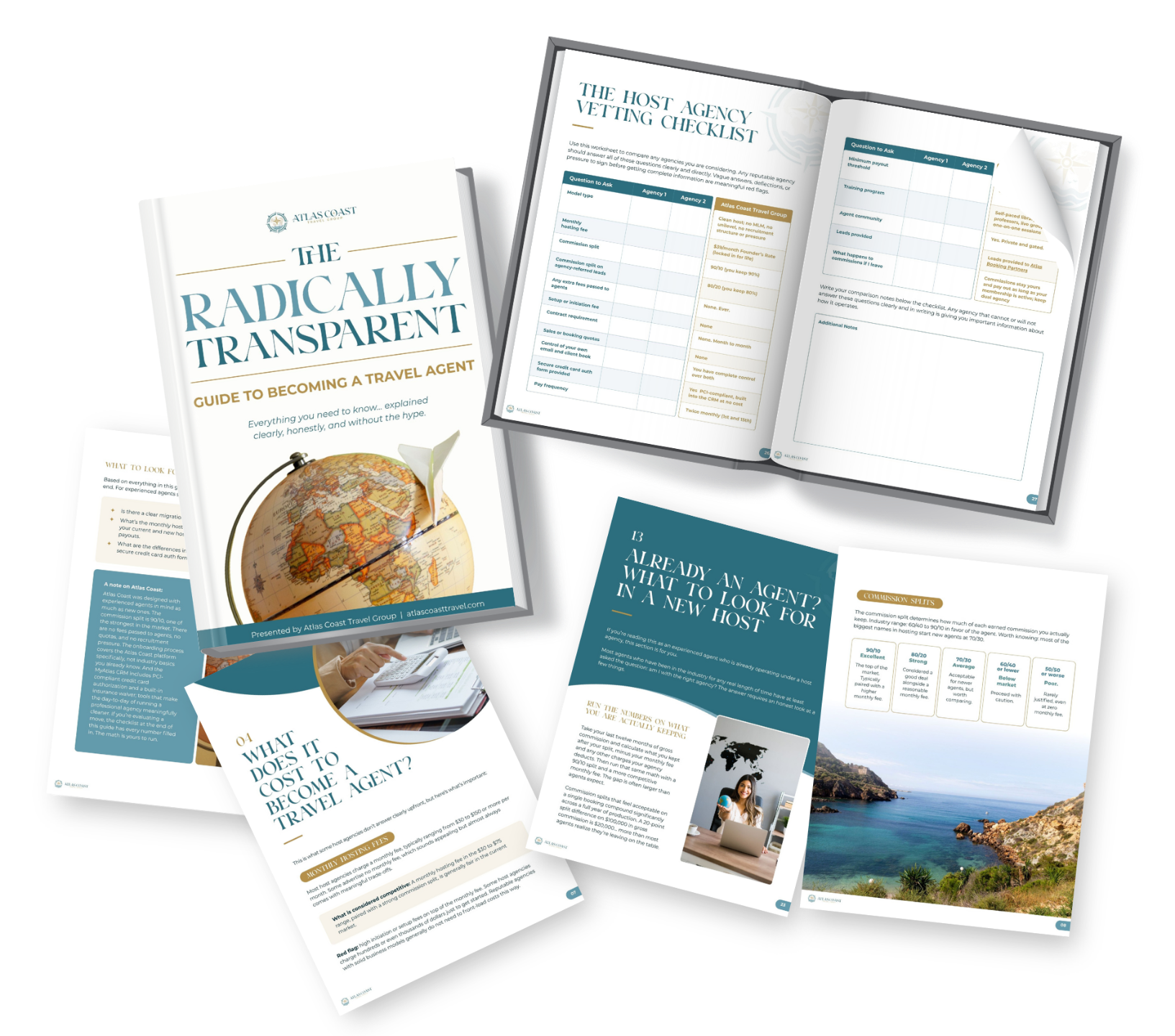
So the general rule is simple: don't apply for an individual membership until you have a booking history, either with your current host or a previous one. If you're brand new and haven't booked anything yet, wait. And if you're an Atlas Coast agent and you're not sure whether you qualify, email [email protected] before you apply. We'll tell you in a minute, and it can save you a full year's dues. We also break down which credentials are worth it, and when, in our free Radically Transparent Guide to Becoming a Travel Agent.
Switching Hosts With a Membership You Already Have
If you already hold a CLIA individual membership from a previous host, good news: you don't cancel it and start over when you move. As long as your new agency is a current CLIA member, CLIA simply updates the agency on file for you.
To do it, call CLIA's membership team at (202) 759-9370 and choose the membership option, rather than hunting for a change setting in the online portal. Give them your new agency's CLIA Agency ID (Atlas agents can find ours in the members' area). If you'd like a new physical EMBARC card reflecting the change, there's a small reissue fee. None of this touches your bookings, since those always run through the agency's credentials no matter what your personal membership shows.
IATAN works differently, and it's the piece people wrongly assume moves with them. Your CLIA individual membership is held by you, as long as your agency affiliation stays current. IATAN registration, though, is tied to the accredited agency where you work, not to you. So if you're changing hosts while you're applying for or holding an IATAN card, confirm the update process with both agencies before you count on your old affiliation carrying over.
The Simple Version
You book under your host agency's CLIA and IATAN credentials from day one, with nothing to buy.
An individual CLIA membership (IAM) is optional. It's worth getting once you're active and you want FAM trips, supplier and hotel perks like Marriott's Fam-Tastic rates, or CLIA certifications. The EMBARC card is the physical ID that comes with it, and it's what people mean when they say CLIA card.
The personal IATAN card is separate again. It's supplier proof that you're a working professional, and unlike the CLIA membership you can't just buy it. You qualify through real sales, and your agency registers you first.
No matter what, every client booking runs through the agency's credentials, not a personal one. When a supplier asks for a number, figure out whether it's verifying the agency behind the booking or you as an individual, and hand over the right one.
FAQ
Do I need my own CLIA number to book travel?
No. The booking credential is the agency's CLIA membership, and it belongs to your host agency. When you book under a host like Atlas Coast, your cruises run through the agency's CLIA number and you have full booking access from day one, with nothing to buy on your own.
What's the difference between a CLIA number and an IATAN number?
They're the two main agency accreditations. Cruise lines generally recognize the agency through its CLIA number, while hotels and most non-cruise suppliers verify it through its IATAN number. Both belong to the agency, so under a host you don't hold either one personally.
Is the EMBARC card the same thing as a CLIA card?
Yes. EMBARC ID is the current name for what used to be called the CLIA card. It's the physical ID that comes with an individual membership, used at FAM trips, supplier events, and training. It identifies you as a professional, and it's separate from the agency CLIA number your bookings run under.
Can I just buy a personal IATAN card the way I buy a CLIA membership?
No. The IATAN card has production requirements, so you have to be actively selling travel and earning enough over the prior year to qualify, and your agency has to register you through its IATAN account before you can even apply. IATAN lists the current thresholds on its ID card conditions page.
Should a brand-new agent buy an individual CLIA membership right away?
Usually not. The dues aren't refundable, they expire December 31 no matter when you buy, and your host has to approve the application after CLIA has already collected your money. The general rule is to wait until you have a booking history and a clear use for the perks before you apply.
What happens to my individual CLIA membership if I change host agencies?
You keep it. You don't cancel and reapply. As long as your new agency is a current CLIA member, you call CLIA's membership team and they update the agency on file for you. An IATAN card works differently, since it's tied to the accredited agency, so confirm that update process separately when you switch.
Sources: Cruise Lines International Association (CLIA); International Airlines Travel Agent Network (IATAN), ID card conditions; Marriott Travel Agents (Fam-Tastic). Credential fees and requirements change, so verify current terms directly with each provider. Last reviewed 2026.
Want to know all the info about becoming a travel agent?