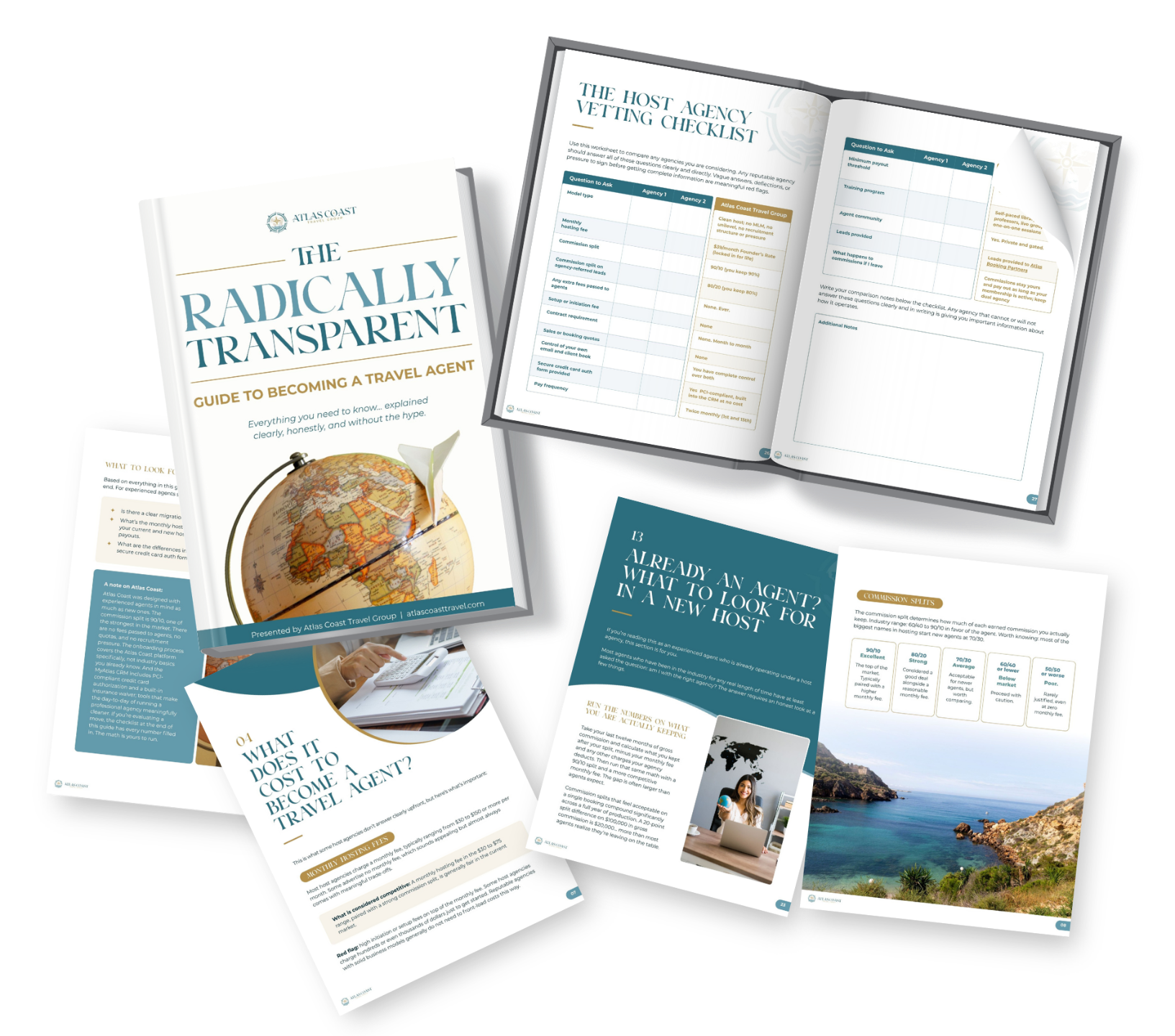
Host Agency Fees Explained: What You'll Actually Pay to Affiliate

- The fee structure nobody explains clearly
- Fee type 1: Monthly or annual membership fees
- Fee type 2: Commission splits
- Fee type 3: Setup or startup fees
- Fee type 4: Technology and tool fees
- Fee type 5: Training and certification fees
- Fee type 6: E&O insurance
- What the total cost of affiliation actually looks like
- Red flags in host agency fee structures
- Costs outside the host agency relationship
- FAQ
The Fee Structure Nobody Explains Clearly
When you research host agencies, you'll find a bunch of fee structures laid out in ways that make comparison hard. One agency leads with "no startup fee." Another leads with "100 percent commission." Another says "everything included for $99 a month."
They're all describing different things, and without a framework to line them up, they're nearly impossible to compare. The agency with the best-sounding number isn't necessarily the best deal.
So here's every fee type you'll run into, what the standard ranges look like, and how to work out your actual total cost of affiliating, so you can compare apples to apples.
Fee Type 1: Monthly or Annual Membership Fees
The most common structure is a monthly or annual membership fee that covers affiliating: access to the host's accreditation, supplier portals, technology, training, and support.
Standard range: $30 to $100 a month, or $200 to $600 a year if paid upfront.
What it usually includes: supplier portal access, CRM access, training curriculum, community access, and agent support.
What varies: the quality of all of that swings a lot. A $30-a-month fee at one agency can include much better training and technology than an $80-a-month fee at another. Monthly cost isn't a reliable quality signal.
What to confirm: Is there a price difference between paying monthly and annually? Does the fee cover everything, or are some features billed separately? What happens to your access if you stop paying, and is there a grace period?
Fee Type 2: Commission Splits
A commission split isn't technically a fee, but it works like the main cost of affiliating. The host's share of your commissions is how it funds the infrastructure, accreditation, and support it provides.
Standard range: 70/30 to 90/10 (your share first).
What drives the difference: training quality, technology, supplier relationships, support level, and volume economics. A host with 5,000 agents has very different math than one with 200.
The critical math: at $100,000 in gross annual commissions, the gap between a 90/10 and a 70/30 split is $20,000 a year to you. That dwarfs any monthly-fee difference. We lay it all out in why the 90/10 split matters.
Fee Type 3: Setup or Startup Fees
Some hosts charge an upfront setup or startup fee when you join. It might cover onboarding, initial tech setup, or it might just be a barrier to entry.
Standard range: $0 to $500. Some franchise models (Dream Vacations, Cruise Planners) carry much higher franchise fees.
When it's reasonable: if it covers something of real value (dedicated onboarding, a custom website, specific tools) and the amount is proportional.
When it's a red flag: a startup fee stacked on high monthly fees and a below-market split suggests the host makes its money on agent fees, not on helping agents book travel.
$0 startup is absolutely doable. Plenty of quality hosts charge nothing to set up, and in today's competitive market it isn't something you should have to pay.
Fee Type 4: Technology and Tool Fees
Some hosts fold all technology into the base fee. Others bill separately for specific tools: CRM, client management, booking tools, website hosting, or marketing systems.
CRM costs: industry CRMs like TravelJoy or ClientBase run about $20 to $50 a month on their own. If your host includes a CRM in the membership, that's real value.
Website hosting: some hosts include an agent website; others charge $15 to $50 a month for it.
Booking tools: most supplier portals are free once you have the host's accreditation. Specialized booking tools or GDS (Global Distribution System) access can cost extra for agents who need them.
How to evaluate: list every tool you'll actually use and check whether it's in the base membership or a separate charge, then total it up.
Fee Type 5: Training and Certification Fees
Training from your host should be included in your membership. If a host charges separately for its own training curriculum, that's worth a closer look.
Supplier certifications, on the other hand, are almost always free, straight from the supplier's agent portal. Royal Caribbean University, Carnival's modules, Celebrity's Essentials, and the like cost nothing. If a host is charging you for training that's free from the supplier, ask what you're really paying for.
Outside industry certifications (CLIA CTA, CLIA ACC, ASTA CTIE) have their own costs set by the issuing body. Those are professional-development investments you make as your career grows.
Fee Type 6: E&O Insurance
Errors and omissions insurance isn't a fee you pay the host. It's a professional policy that protects you against claims arising from professional mistakes. Here's what E&O insurance covers and why you need it.
Some hosts carry an E&O policy that covers your bookings made under their brand and credentials. That's a real benefit, but read the conditions closely, because host E&O generally protects you while you're working through the host, and not once you're operating fully under your own brand with your own staff. This is how the E&O product works across every insurer, so a host that promises blanket coverage for everything you do is overstating it.
If you need your own coverage, an individual travel E&O policy generally runs a few hundred to about a thousand dollars a year depending on limits. It's a business expense, not something to skip.
What the Total Cost of Affiliation Actually Looks Like
Here's a realistic annual cost for a new agent at a quality host under three different fee structures.
- Annual membership: $588
- CRM: included
- Training: included
- Annual commissions at $30,000 gross: you net $27,000
- Total annual fees to you: $588
- Year 1 total fees: $900 + $200 = $1,100
- Annual commissions at $30,000 gross: you net $24,000
- Difference from Scenario A: you net $3,000 less per year
- Annual fees: $600
- Annual commissions at $30,000 gross: you net $21,000
- Difference from Scenario A: you net $6,000 less per year
The monthly-fee differences here ($49, $75, and $50) are dwarfed by the split. The split is the bigger number, every time.
Red Flags in Host Agency Fee Structures
High startup fees with no clear deliverable. A $500 startup fee that produces a login and a PDF welcome packet isn't a justified cost.
Multiple separate fees for basic functionality. If the base membership doesn't include CRM access, booking tools, and training, and each of those is a separate add-on, the real cost is a lot higher than the headline monthly fee.
Fees with no published terms. A host that tells you the fee but won't show you what you're actually getting in writing is asking you to trust a verbal promise. Don't. Our contract guide covers exactly what to read before you pay.
Fees combined with a low split. Significant monthly fees plus a split below 80 percent suggests an agency whose revenue depends on agent fees rather than its share of agent production. Not always the case, but worth a closer look.
Costs Outside the Host Agency Relationship
Beyond host agency fees, a new travel agent should budget for:
Business formation: $50 to $500 depending on your state and entity type.
Seller of Travel registration (where it applies): $100 to $700 for the four states that require it (California, Florida, Hawaii, Washington). Here's how seller of travel laws work by state.
Professional development: industry conferences run $100 to $2,000 per event, and CLIA or ASTA membership adds $100 to $300 a year. Optional, but valuable.
Marketing: website, social ads, email tools. You can keep it to $100 to $500 a year; $500 to $1,500 a year produces more consistent results.
CLIA individual agent membership: $89 to $139 a year for your personal CLIA card, if you choose to get one.
According to data published by Travel Planners International through Host Agency Reviews (2025), a realistic total startup cost for a new agent runs from $1,500 to $3,000 at the lean end up to $7,000 or more for a fuller launch.
Monthly membership: $49/month. No startup fee. No setup fee. 90/10 split on self-sourced bookings, 80/20 on agency-generated leads. Pay dates: the 1st and 15th. Minimum payout: $25, which rolls forward and never expires.
On E&O, we tell you the truth most hosts gloss over: Atlas Coast carries a $2 million errors and omissions policy that covers your bookings made through Atlas Coast Travel Group when your marketing includes the independent-contractor disclaimer, you have no employees or sub-agents booking under you, and any claim is brought in the US or Canada. It isn't voided just because you market under your own brand name, and as you grow we recommend carrying your own individual policy too.
We publish all of this before you make any decisions, so you can compare it to anything else in the market with the full picture in front of you. That's by design. See it on the Why Atlas page, grab the free guide, watch the free agent webinar, and join Atlas Coast when you're ready.
FAQ
What is the average monthly fee for a host agency?
Most host agencies charge between $30 and $100 a month. But the monthly fee alone isn't a useful comparison point without also knowing the commission split and what's actually included.
Is a host agency startup fee normal?
Startup fees exist across the industry but aren't universal. Plenty of quality hosts charge none. If you're asked to pay a significant startup fee, ask exactly what it covers and whether it's refundable in any circumstance.
What is the minimum cost to start as a travel agent?
Industry research puts the lean minimum at $1,500 to $3,000, covering host agency fees, business formation, and basic tools. That assumes a minimal marketing budget and no professional certifications beyond what's required.
Are host agency fees tax deductible?
Generally yes, as a business expense for an independent contractor running a travel business. Check with your accountant for your specific situation, and keep records of every fee you pay.
What happens to money I've already paid if I cancel my membership?
That depends on the host's refund policy. Month-to-month memberships usually end at the close of the paid period with no refund. Annual prepaid memberships may or may not include a prorated refund. Read the contract before you pay.
Sources: Travel Planners International startup cost data (Host Agency Reviews, 2025); Host Agency Reviews fee structure comparison data; industry standard ranges from ASTA and HAR.
Want to know all the info about becoming a travel agent?