How Travel Agents Actually Get Paid

For New & Aspiring Advisors
You book a client on a $6,000 cruise. The supplier pays 10 percent commission. You do the quick math in your head and land on $600. Nine months later, $360 shows up in your account.
Nothing went wrong. Nobody took anything from you. The $360 can be completely correct, and understanding exactly how $600 became $360 is one of the most useful things you can learn in your first year. Until you can trace it, you can't estimate your income, you can't plan around when money will arrive, and you can't tell a normal payout apart from a commission problem worth chasing.
Where the money actually comes from
Before the commission rate or the host split matters, a booking has to survive one yes-or-no question: was it eligible for commission in the first place?
Start with the payment trail. On a commissionable cruise, resort, hotel, tour, or package, the client pays the supplier. The supplier later pays the agency named on the reservation. The agency then pays you. You're third in line on money that usually never passes through your hands. That's why a client can often use a travel advisor without paying more for the booking itself. The supplier already has a commission agreement with the agency.
Now the word doing quiet work in all of this: eligible. A booking earns commission only when it's made through an approved supplier account, under the agency's credentials, with you attached correctly and the required details entered correctly. The expensive rookie mistake is booking on a consumer website and expecting the reservation to connect itself to your host agency afterward. Unless the supplier has a process that allows the booking to be transferred, and you complete that transfer inside its rules, the reservation was never attached to the agency. If a booking isn't commission eligible, the rate is irrelevant, the split is irrelevant, and the expected commission is zero.
Some advisors also charge separate professional fees for planning, research, or servicing, and that's its own income stream. Here we're following supplier commission from the reservation to your bank account.
Why you may wait months to get paid
An eligible booking can still make your first year feel like nothing is happening, because advisors do the work long before suppliers release the money.
Your client books today and sails next spring. You might research in August, book in September, handle changes through the winter, and watch the client travel in May. Most leisure suppliers don't owe commission simply because the reservation exists. Payment is generally tied to the client completing travel and to the supplier's own payment terms. Some suppliers pay earlier, some later, and cancellations, refunds, changes, and other adjustments can change whether commission is owed and how much.
Run the full timeline. The supplier releases commission after travel. Your host receives it, matches it to the correct reservation, applies your split, and includes it in a payout run. You can be paid in June or July for work you started nearly a year earlier. That lag is why year one is so misleading. You're filling the front of the pipeline while very little has reached the back. Later, older trips complete while new bookings enter, and payments start arriving more consistently. The business didn't suddenly get easier. The pipeline finally had time to mature.
This is also why it's risky to treat early bookings like immediate income. Rent, software, and ordinary life arrive on a calendar. Supplier commission doesn't. At Atlas, advisors can open a missing-commission inquiry once 60 days have passed since the client's travel end date. That's a waiting period, not a deadline. The reason a window exists is simple: the supplier needs time to release the money, and the agency needs time to identify and match the payment. When you're comparing hosts, ask each one when it will investigate a missing commission and why.
The number the percentage actually applies to
Here's the first part of the missing $240, and it's the step most new advisors never knew they were skipping. The supplier's commission rate doesn't necessarily apply to the total the client paid. It applies to the commissionable amount, and those can be very different numbers.
Taxes, government charges, port fees, and whatever the supplier labels as noncommissionable fare sit outside the calculation. On our $6,000 teaching example, the supplier might identify around $4,000 as commissionable. So 10 percent isn't multiplied by $6,000. It's multiplied by $4,000, which is $400. The advertised rate can be completely accurate while your expectation is still wrong, because the rate was pointed at a different base number. That first $200 didn't disappear after the booking. It was never part of the commission calculation.
Learn where each supplier shows the commissionable amount or the expected gross commission. It may appear in the booking portal, on an invoice, in the agency view, or on the commission statement. That's the number you need before you estimate what a reservation will pay. And be careful with rate charts shared in advisor groups. A chart may assign each cruise line a neat percentage, but your actual rate can depend on the agency's contract, production level, product, booking category, group agreement, promotional terms, and the year the agreement applies. Two agencies can get different rates from the same supplier. A screenshot from somebody else's portal isn't your compensation agreement.
Then the host split, and only then
Now, and only now, does the host split explain the rest of the missing money. The host takes its share of the supplier commission, not a percentage of the entire trip price. On the $400 gross commission, a 90/10 split leaves the advisor $360 and the host keeps $40. That's how a $6,000 cruise at a stated 10 percent commission produces a $360 advisor payout without anyone making an arithmetic error.
Burn the order of operations into your head: commissionable amount first, supplier rate second, host split third. Use the wrong starting number or apply the split in the wrong place and your estimate will be off, usually in the direction that makes the eventual deposit feel disappointing.
The split is also one of the biggest financial variables in a host decision. On that same $400 gross commission, a 90/10 split pays the advisor $360 while a 50/50 split pays $200. That's a $160 difference on one reservation before any other fees. At Atlas, advisors keep 90 percent on clients they bring in. Leads generated by Atlas run 80/20, and repeat bookings return to 90/10 once that client relationship belongs to the advisor.
A high split doesn't automatically make a host a good value, though. You also have to price the monthly fee, booking fees, technology costs, training, support, supplier access, lead ownership, and payout charges. A high percentage of very little is still very little, and a lower split can sometimes include support or leads that create more total income. The right comparison is the entire arrangement, not the largest percentage on the sales page. Watch the phrase "earn up to" as well. It describes a ceiling, not necessarily the split you get when you join, so find your actual starting split and the requirements for any higher tier in writing.
Want to see what that adds up to over a year? Read How Much Do Travel Agents Make? And if you're still deciding whether this career fits, start with How to Become a Travel Agent.
What can come out after the split
The $360 still isn't safe until you know whether the host deducts anything after, or even before, applying the split. Ask whether each payout can include processing charges, administrative charges, booking fees, technology fees, or wire fees. Then ask the follow-up most people miss: is the deduction taken from gross commission before the split, or from your share after the split? The same fee lands differently depending on where it's applied. At Atlas, there's no processing fee on a standard payout. The amount shown as your share is the amount that lands, apart from legally required withholding or an adjustment already described in the agreement.
Then there are chargebacks. A supplier can pay commission and later reverse it because the client canceled, got a refund, or disputed the charge. If the money already reached you, the agreement should explain how the reversal is handled. This is why commission statements aren't optional bookkeeping decoration. Every deposit should trace to a supplier, client, booking, gross commission, split, and any adjustment. A number that appears in your bank account without an explanation leaves you unable to audit your own business.
The questions that get expensive later
The most expensive payout term often doesn't affect you until months after you join, which is exactly why people forget to ask about it at signup. Start with minimum payouts. Some hosts won't release a payment until your balance reaches a threshold. Ask how large it is, whether smaller balances roll forward, whether they ever expire, and whether a fee applies when the payout is issued. Atlas uses a minimum of $25, and smaller balances roll into the next payout cycle rather than disappearing.
Then ask what happens when the relationship ends. This gets oversimplified online because people blend three different things: money the agency already received, commission already earned under the agreement, and future commission on clients who've booked but haven't traveled. Get four answers in writing before you join. When is commission considered earned? What happens to money the agency already holds? What happens to future bookings for clients who haven't traveled? Who services those clients after you leave? Atlas publishes its independent contractor agreement before signup, so you can read the written terms before paying. Whether another host publishes its agreement or provides it on request, ask for the contract early and read it before money changes hands.
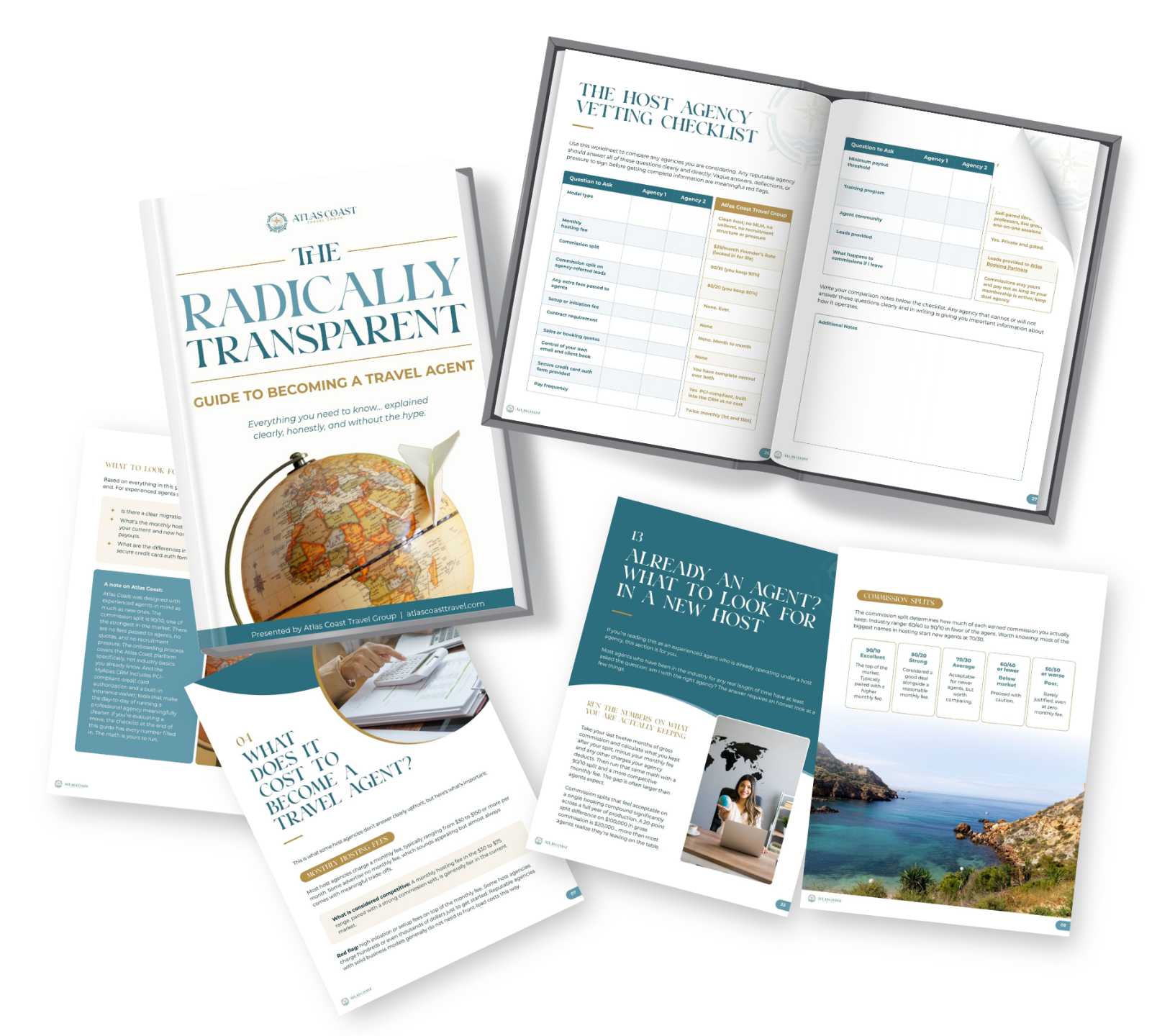
Atlas Coast is a non-MLM host agency built on radical transparency: a 90/10 split on the clients you bring in, a published contract you can read before you pay, and no games with your payouts. Start with the free Radically Transparent Guide to Becoming a Travel Agent, save a seat at the free webinar on becoming a travel agent, or see how joining Atlas Coast works.
FAQ
Why did my commission arrive months after the booking?
Most leisure suppliers pay commission after the client completes travel, on their own payment terms. Your host then receives the payment, matches it to your reservation, applies your split, and includes it in a payout run. A booking made far in advance can take many months to pay, and that's normal.
Does a 10 percent rate mean 10 percent of the total trip price?
Usually not. The rate applies to the commissionable amount, which typically excludes taxes, government charges, and port fees. Find where your supplier shows the commissionable amount before you estimate what a booking will pay.
What does the host split apply to?
The split applies to the supplier commission, not the whole trip price. The order is commissionable amount first, supplier rate second, host split third.
What should I ask a host before joining?
Get the payout rules and the exit rules in writing: your actual starting split, any fees and where they apply, the minimum payout and whether it rolls forward, when commission is considered earned, and what happens to future bookings and clients if you leave.
Sources: American Society of Travel Advisors (ASTA); Cruise Lines International Association (CLIA); Host Agency Reviews.
Want to know all the info about becoming a travel agent?