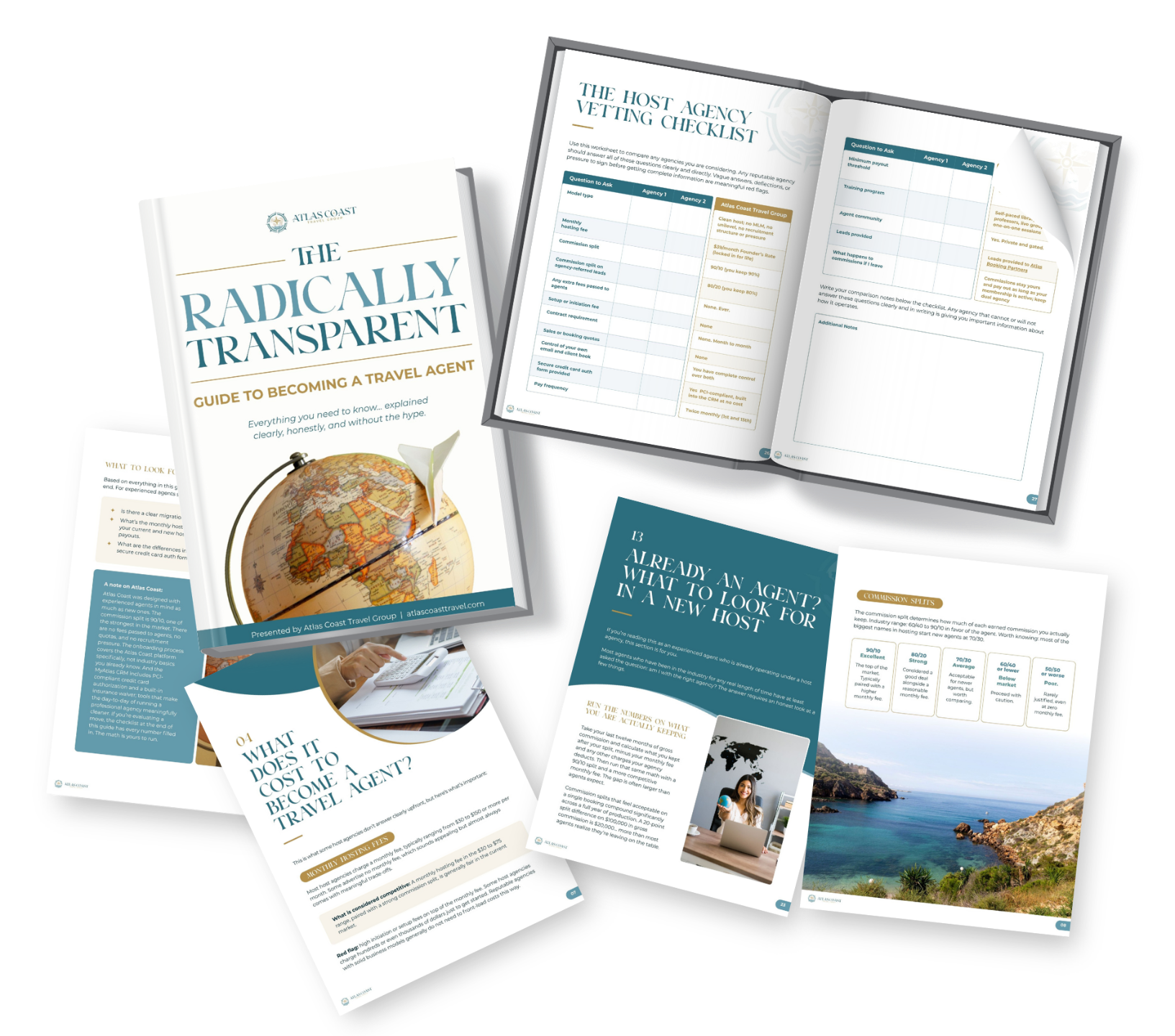
How to Read Host Agency Income Claims Without Getting Misled

Agent Education
- Why this post exists
- The difference between mean and median, and why it matters here
- What "part-time" means in income surveys
- The volume required to produce claimed incomes
- How commission rates affect the math
- Benchmarks that are actually useful
- What Atlas Coast publishes and why
- Red flags in how income claims are presented
- How to ask for numbers before you join
- FAQ
Why This Post Exists
I'm a university professor. My job is to help people understand research: how it's built, what the numbers actually measure, which claims the data supports and which are extrapolations, projections, or marketing. I teach people to read critically, question the framing, and ask the right follow-up questions.
When I started researching host agencies, I pointed that same lens at the income claims I kept seeing. What I found wasn't fraud, exactly. Most of it is technically accurate in the narrow sense of what was actually measured. But the framing ranges from helpful to misleading depending on who's presenting it and what they want you to conclude.
I built Atlas Coast on radical transparency, and that extends to income claims. This is the post I wish had existed when I was researching this industry, and it's the one I want every prospective agent to read before making a financial decision based on income data they found online.
The Difference Between Mean and Median, and Why It Matters Here
This isn't complicated, but it matters.
The mean is the average: add up all the values and divide by how many there are. The trouble with the mean in a skewed distribution, where a handful of values at the top are very large, is that those high-end numbers drag the average up in a way that doesn't reflect most people's experience.
The median is the midpoint: half the values sit above it, half below. In a skewed distribution, the median gives you a truer picture of what a typical person sees.
Travel agent income is skewed. A small number of high-producing luxury advisors, cruise specialists, and destination-wedding agents earn $150,000 to $500,000 or more a year. A large number of agents earn $5,000 to $40,000. The mean gets pulled up by the high earners in a way the median doesn't.
When you see an income figure with no note of whether it's mean or median, assume it's the mean unless told otherwise, and adjust. A mean of $45,000 in a skewed distribution might have a median closer to $18,000. Both are accurate descriptions of the same dataset. They imply very different typical experiences.
The most useful income data reports both mean and median, segments by experience and business type (full-time vs part-time, hosted vs independent, niche), and is clear about who's in the sample. For the plain-English version of realistic earnings by stage, see how much travel agents actually make.
What "Part-Time" Means in Income Surveys
Travel agent income surveys usually split respondents into full-time and part-time, and the cut is usually self-reported hours: agents say how many hours a week they work the business, and the survey sorts them.
The problem: "part-time" covers an enormous range.
An agent working 5 hours a week who books two cruises a year for family is "part-time." An agent working 25 hours a week with a focused niche and $80,000 in annual commission is also "part-time" if that's under the "full-time" threshold. Both land in the same bucket.
So when you see "part-time travel agents earn an average of $X," the real question is: what's the distribution inside that category? The spread within "part-time" is often wider than the gap between "part-time" and "full-time."
A more useful breakdown treats hours as a continuous variable, or buckets them (0-10, 10-20, 20-30, 30+) and reports income in each. It's not always available, but it's what to look for when it is.
The Volume Required to Produce Claimed Incomes
When you see an income claim, the follow-up is: what booking volume does that income take?
Typical commission rates:
- Cruise bookings: 10 to 16 percent of the cruise fare (not taxes and port fees)
- All-inclusive resort bookings: 10 to 15 percent of the total room cost
- Land packages: 8 to 12 percent depending on supplier
- Air-only: near zero for most independent agents (airlines cut base commissions in the 1990s, so most agents don't book standalone air for commission)
At a 10 percent commission on a $3,000 average cruise fare per passenger, one booking earns $300. To earn $60,000 at $300 a booking takes 200 bookings a year.
200 bookings a year is about 4 a week, every week, with no time off.
At a more typical experienced-agent rate of $600 to $900 a booking (higher-value sailings, better commission tiers unlocked at volume, add-ons), you need 67 to 100 bookings a year. That's 1 to 2 a week, which is doable, but it's a real, functioning travel business, not a casual side operation.
The arithmetic isn't hard, but it's almost never shown next to the income claim. Run it yourself every time. How many bookings does this take? How many clients is that? Is that realistic for where I'm starting?
How Commission Rates Affect the Math
Commission rates aren't uniform. They vary by:
- Supplier: different cruise lines, resort brands, and tour operators pay different base rates.
- Agency volume: hosts with higher overall booking volume earn higher "preferred" rates from suppliers. A host doing $30 million in annual cruise sales earns better tiers than one doing $3 million, and that flows to agents as a higher starting rate.
- Agent volume: many suppliers have tiered structures where your rate climbs as your own production with them grows.
- Commission split: your net isn't the gross. If your host takes 30 percent, a 15 percent gross commission becomes 10.5 percent net to you.
When income surveys report per-booking averages, they're usually reporting gross commission, not take-home after the host split. An agent earning $870 a booking (a figure that shows up in HAR data for experienced agents) isn't taking home $870 before taxes. That's gross, before the host's share.
At a 90/10 split, the agent nets $783 of that $870. At 70/30, $609. Over 100 bookings a year, the split alone is a $17,400 difference. That's a big number, and it's invisible if you only look at gross per-booking figures without asking what split they assume. We run the full breakdown in why the 90/10 split matters.
Benchmarks That Are Actually Useful
With all that context, here are the figures from industry data I find genuinely useful for prospective agents:
Year 1 realistic range: $5,000 to $15,000 for most new agents, most of whom are part-time or transitioning to full-time. This accounts for building a client base from scratch, learning the booking systems, and the fact that cruise commissions usually aren't paid until after the client sails.
Year 2 to 3 range: $15,000 to $40,000 for agents who are actively booking and building a referral base. Agents with a focused niche and prior sales or marketing experience tend toward the higher end.
Experienced agent benchmark (5+ years, full-time): HAR data puts the average experienced-agent booking at about $870 in gross commission. Agents booking 50 to 100-plus a year land in the $40,000 to $90,000-plus gross commission range. Net, after the host split, is meaningfully below gross.
Luxury specialist benchmark: HAR data indicates more than half of luxury travel advisors earn over $75,000 a year. The caveat: the luxury segment has higher entry barriers (personal product experience, supplier relationship investment, a higher-income client base) and isn't where most new agents start.
These are national survey averages, shaped by geography, niche, client-acquisition approach, and how much time the agent actually puts in. Treat them as reference points, not promises.
What Atlas Coast Publishes and Why
Atlas Coast publishes a realistic Year 1 expectation of about $12,000 for new agents who engage with the training, finish their supplier certifications, and work their client base consistently. We landed on that by looking at what agents actually earn in year one, not at what we'd like the number to be for recruiting.
$12,000 in year one is about $230 a week. It isn't a full-time income for most people. If you come in expecting to replace a salary in year one, it'll feel disappointing. If you understand how any commission business ramps, where early-year earnings reflect investment and relationship-building rather than the steady state of a mature book, it's honest context.
I publish it because agents deserve it before a financial decision, and because the recruiting trap of implying unrealistic first-year income is one I refuse to take part in.
I also publish our commission structure (90/10 on self-sourced bookings, 80/20 on agency-generated leads), our fee ($49 a month, no startup fee), and our pay schedule (1st and 15th, $25 minimum payout). You can verify all of it before you sign anything, and our full agent contract is public too. I don't know another host that puts all of this out before the application.
Red Flags in How Income Claims Are Presented
Ranges with no explanation of what drives them. "Agents earn $20,000 to $200,000 a year" tells you nothing useful. It's technically accurate and practically useless. A wide range with no distribution and no description of what separates the low end from the high end is a rhetorical move, not data.
Impressive totals with no per-agent context. "Our agents collectively earned $14 million last year" sounds great. Across how many agents? Spread over 1,400 agents, that's $10,000 each on average, a very different statement than the headline.
"Average" with no mean-or-median. See the first section. Always ask which one.
Claims that don't subtract the host split. If the claim is "our agents earn X per booking," that's gross, before the host takes its share. At a 70/30 split, the agent's net is a lot lower than the gross figure.
Top-producer testimonials passed off as typical. "My agent Sarah earned $85,000 last year" may be completely true. It's true about Sarah. It isn't a prediction about you. The high-end testimonials get chosen precisely because they're unusual.
Growth claims with no base. "Our agents grew their income 40 percent last year" could mean they went from $5,000 to $7,000. A growth percentage with no stated starting point isn't useful.
How to Ask for Numbers Before You Join
Before you join any host, you have every right to ask specific questions about income, and a legitimate agency will answer them. Here's what to ask:
What's the median first-year commission income for active agents who joined in the last two years? Active means they finished onboarding and booked at least one client, not just enrolled.
What percentage of agents who join are still active 18 months later? Retention reveals what gross income averages hide. If 60 percent quit within 18 months, the "active agent" income data quietly excludes everyone who left.
What's your gross booking volume per active agent? Volume divided by agents gives you a productivity figure that's more stable than income (income depends on split and client mix, volume is more directly comparable).
What does the income distribution look like in my likely starting niche? A host built around luxury advisors will show very different data than one focused on cruise or all-inclusive specialists. Make sure it's apples to apples.
Any host that won't engage with these, or answers in marketing language instead of data, is telling you something important about its relationship with transparency.
We publish a realistic Year 1 expectation of about $12,000 for engaged new agents. We show you the full fee structure, the commission split, and the pay schedule before you sign anything, and our agent contract is public. We don't do this because anyone requires it. No one does. We do it because the decision to start a travel business deserves accurate information, and we'd rather have 50 agents who knew what they were signing up for than 500 who felt misled. The numbers are on the Why Atlas page, you can grab the free guide, watch the free agent webinar, and join Atlas Coast when you're ready.
FAQ
Is the income data from travel agent surveys reliable?
Data from sources like Host Agency Reviews and ASTA comes from voluntary surveys, which introduces selection bias: agents who respond may differ systematically from those who don't. Self-reported income can also be imprecise. It's useful as a directional benchmark, not a precise prediction. The most reliable way to calibrate is to find agents in your target niche and ask them directly.
Why do income claims for travel agents vary so widely?
Because "travel agent" covers everything from a retiree who books two family vacations a year to a full-time luxury advisor running a seven-figure practice. Both are travel agents. Income depends on hours worked, niche, years of experience, client-acquisition approach, the host's commission structure, and the agent's starting network. Wide ranges are honest, they're just not very useful without more specificity.
What's the difference between gross commission and net income?
Gross commission is what the supplier pays. Net income is gross minus the host's share (the split), minus business expenses (fees, tools, marketing, E&O, professional development), minus taxes. An agent earning $60,000 in gross commission on a 90/10 split nets $54,000 in commissions before expenses and taxes. On a 70/30 split, the same gross yields $42,000. Taxes and expenses reduce both further.
How long does it take to build a full-time income as a travel agent?
Industry benchmarks point to 3 to 5 years of consistent effort to build a genuinely full-time income from scratch. Prior sales experience, marketing skills, or an existing warm network can compress that. Treating the business casually in the first couple of years tends to stretch it out instead.
Does it matter which host agency I join for income potential?
Yes, in two big ways. First, the split directly sets your net from any gross commission: a 90/10 split produces about 28.5 percent more take-home than a 70/30 split on the same volume. Second, hosts with higher overall volume earn better rates from suppliers, so the gross commission on a given booking can be higher through a preferred-rate host than a smaller one. Split plus preferred supplier rates together set your real earning capacity at a given volume.
What does Atlas Coast say Year 1 agents typically earn?
We publish a realistic expectation of about $12,000 in Year 1 for engaged agents who finish onboarding, complete their supplier certifications, and actively work their client base. It's a national average for new agents drawn from industry data and our own experience with early-stage agents. It isn't a guarantee, and agents who come in with stronger networks or prior sales experience often beat it. We tell you the number before you apply because that's how a financial decision should be made.
Sources: Host Agency Reviews Travel Agent Income Survey data; ASTA advisor compensation research; Host Agency Reviews income methodology documentation.
Want to know all the info about becoming a travel agent?