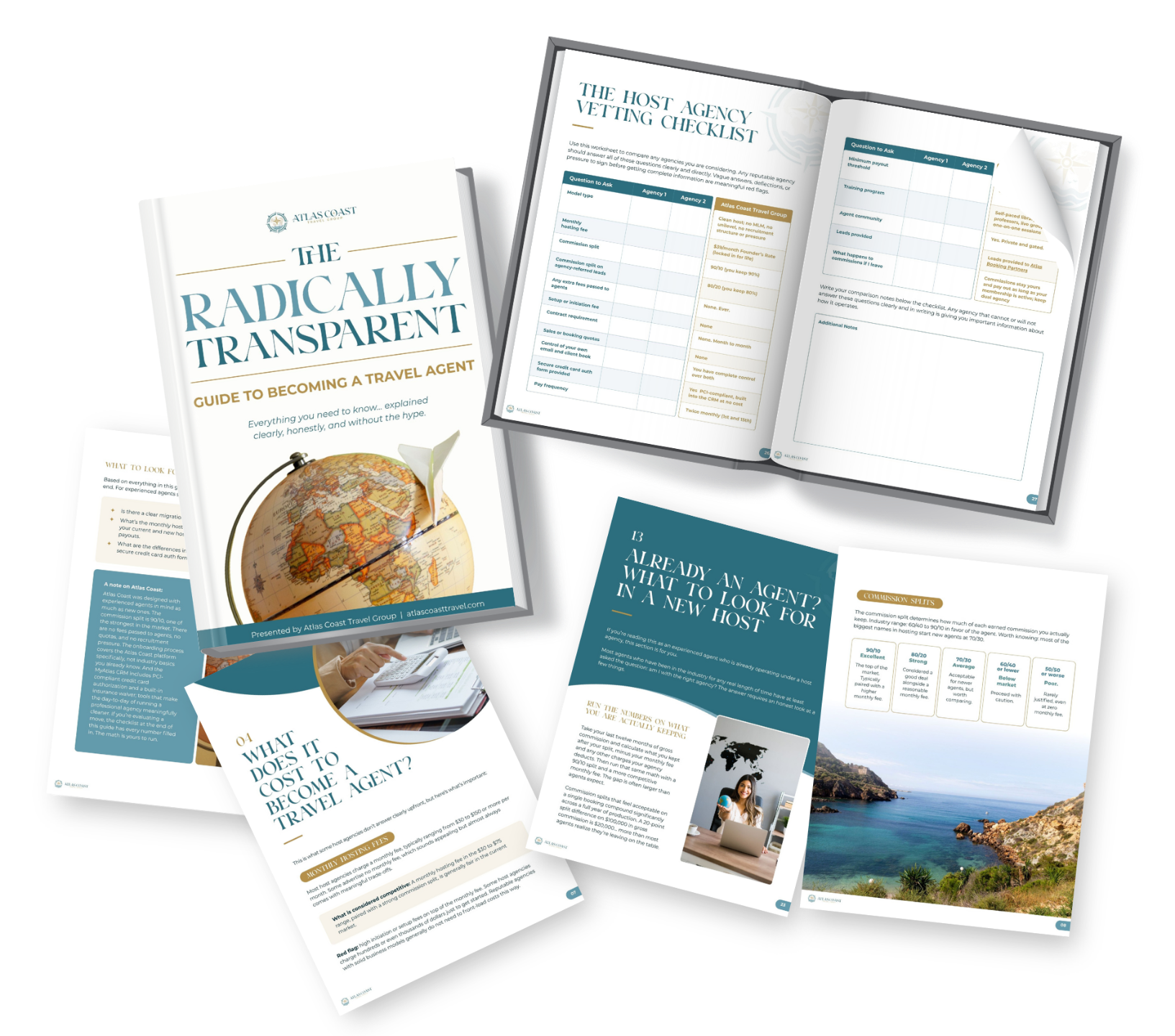
Why the 90/10 Commission Split Matters

- Why this number matters more than almost anything else
- How the math actually works
- The split comparison at different income levels
- What the host agency does with their share
- When a lower split is worth it
- When a lower split is not worth it
- How to evaluate total cost, not just split percentage
- The split question to ask before you join anything
- FAQ
Why This Number Matters More Than Almost Anything Else
When you're evaluating host agencies, you'll weigh a lot of things: training quality, supplier relationships, community, technology, support. They all matter.
But your commission split is the one you'll feel in your paycheck every single month for as long as you're with that agency.
A 20-point swing in your split isn't an abstraction. At any real volume, it's the difference between a side income and a living. So let's do the math plainly, so you can see exactly what your split is worth at every income level. For the bigger earnings picture, here's what travel agents actually make.
How the Math Actually Works
Start with a single booking.
You book a client on a cruise. The fare is $6,000, and the cruise line pays your host a 12 percent commission. That's $720 gross.
Your host takes its split and pays you your share.
| Split | You receive | Host receives |
|---|---|---|
| 90/10 | $648 | $72 |
| 80/20 | $576 | $144 |
| 70/30 | $504 | $216 |
On one booking, the gaps are $72 and $144. Not huge. Now multiply by a year of bookings.
The Split Comparison at Different Income Levels
$30,000 gross annual commissions:
- 90/10: You net $27,000
- 80/20: You net $24,000
- 70/30: You net $21,000
Difference between 90/10 and 70/30: $6,000 a year.
$60,000 gross annual commissions:
- 90/10: You net $54,000
- 80/20: You net $48,000
- 70/30: You net $42,000
Difference between 90/10 and 70/30: $12,000 a year.
$100,000 gross annual commissions:
- 90/10: You net $90,000
- 80/20: You net $80,000
- 70/30: You net $70,000
Difference between 90/10 and 70/30: $20,000 a year.
At $100,000 in gross commissions, the gap between a 90/10 host and a 70/30 host is $20,000 a year. That's not a rounding error. It's a real income difference, and it compounds across your whole career with that agency.
What the Host Agency Does with Their Share
A 10 percent share sounds like almost nothing. How does a host survive on that?
Volume. If a host has 1,000 agents each producing $50,000 in gross commissions a year, its 10 percent comes to $5,000,000. The model works at scale, and it holds up because the host isn't doing 1,000 agents' worth of client work. It's providing infrastructure, accreditation, and support to 1,000 independent businesses, which is a completely different cost structure.
A 70/30 host with fewer agents can earn about the same off a much smaller base. Different model, and often the services are more hands-on and more expensive to deliver.
When a Lower Split Is Worth It
There are real situations where a lower split is the right trade.
When the host has much better commission rates with suppliers. If your host has negotiated higher commission tiers with cruise lines through its volume, you might earn 14 percent from a supplier where a smaller host earns 10. If that supplier-rate gap is big enough, it can outweigh a lower agent split. Run the specific math for the suppliers you actually plan to book.
When the training and support is genuinely better and you need it. A new agent who washes out in year one because the support wasn't there earned zero, whatever the split was. If a lower-split host gives you substantially better training, mentorship, and help finding clients, and that actually lifts your booking volume, it can be worth the trade while you're building.
When the host hands you technology you'd otherwise pay for. A CRM, client management, marketing tools, these cost real money. If a lower-split host bundles them in and you'd otherwise spend $100 to $200 a month on the equivalent, the comparison shifts. More on that in host agency fees explained.
When a Lower Split Is Not Worth It
When the host's services aren't meaningfully better. If a 70/30 host and a 90/10 host give you roughly the same training, technology, and supplier access, the split is the only financial variable that's different, and the 90/10 host wins by $20,000 a year at $100,000 in production.
When you're experienced and don't need hand-holding. An agent coming over from another agency with an established book needs almost no onboarding. Paying a 30 percent override for training you'll never open isn't a good trade.
When the low split comes bundled with high monthly fees. Some hosts pair a 70/30 split with a monthly fee on top. Add it all up and the total cost of affiliating is a lot higher than a 90/10 split with no fee or a small one. Always run the combined number.
How to Evaluate Total Cost, Not Just Split Percentage
The split percentage isn't the only number. The real figure is the split plus any fees, minus the dollar value of services that genuinely help your business.
Here's how to run it:
- Estimate your annual gross commissions, and be honest about it.
- Work out what you'd net at each split: gross x your percentage.
- Subtract annual fees from each scenario.
- Find any services that have real dollar value to you and are included at one host but not another, and assign them conservative dollar values.
- Compare the final net numbers.
For most agents with growing volume who can run fairly independently, the higher-split option comes out ahead. The math tilts the other way for newer agents who lean on more infrastructure.
The Split Question to Ask Before You Join Anything
Before you join any host, ask these specific questions:
- What's the standard commission split?
- Are there any extra overrides or deductions beyond the stated split?
- Does the split change at different volume tiers, and if so, when?
- What happens to my split if I hit a certain production milestone?
- What's the split on agency-generated leads versus my own self-sourced bookings?
That last one matters a lot. Some agencies give you a great split on your own bookings but take a bigger cut on the leads they hand you. We disclose ours at Atlas Coast (90/10 on bookings you source yourself, 80/20 on agency-generated leads) because you should know it going in, and not every agency makes it clear. Our contract guide walks through where to find this in any agreement.
Self-sourced bookings: 90/10, you keep 90 percent.
Agency-generated leads: 80/20, you keep 80 and Atlas Coast keeps 20.
Membership: $49 a month.
No setup fees, no lock-in, no startup cost.
We publish all of it before you join, because you should know what you're agreeing to and be able to hold it up against any other host's terms. See the full breakdown on the Why Atlas page, grab the free guide, watch the free agent webinar, and join Atlas Coast when you're ready.
FAQ
What is a good commission split for a travel agent?
Industry standard runs from 70/30 to 90/10. If you're reasonably self-sufficient and don't need much hand-holding, 80/20 or better is a fair baseline. Anything below 80/20 should come with a strong reason, like services, technology, or supplier access that genuinely makes up the income difference.
Why does the host agency keep any percentage at all?
The host's share pays for maintaining industry accreditations like CLIA and IATAN, building and keeping supplier relationships, running commission processing, providing technology, and delivering training and support. Those cost real money, and the split is what funds them.
What's the difference between a commission split and a planning fee?
A commission split divides the supplier-paid commission between you and the host. A planning fee is a separate charge some agents bill clients directly for their time on complex trips. In most agreements planning fees aren't subject to the split, but confirm it in your contract. We get into this in should travel agents charge planning fees.
Can the commission split change after I join?
Depends on your contract. Some lock in a specific split. Others let the host change terms with notice. Read the contract for this exact provision.
Is a 100 percent commission split possible?
Yes, but it usually comes with higher monthly fees that eat the benefit. A host charging $200 a month for 100 percent commissions may or may not beat a host charging $49 a month for 90 percent, depending on your volume.
Do commission splits apply to planning fees I charge clients?
In most agreements, but not all, the split applies only to supplier-paid commissions, not to service fees you bill clients directly. Read your contract, and if it's vague, ask for written clarification.
Sources: Host Agency Reviews commission structure analysis; industry commission tier data from CLIA and major cruise line partners.
Want to know all the info about becoming a travel agent?