How to Become a Travel Agent in 2026

- The honest version of this answer
- Watch: the quick version
- Step 1: Understand what you're actually getting into
- Step 2: Choose a niche
- Step 3: Affiliate with a host agency
- Step 4: Get trained
- Step 5: Handle the legal and compliance basics
- Step 6: Build your supplier knowledge
- Step 7: Start building your client base
- What separates agents who stick from agents who quit
- FAQ
The Honest Version of This Answer
You don't need a license or a degree to become a travel agent in the United States. That surprises people, so it's worth saying plainly.
What you do need is a mix of professional affiliation, real product knowledge, and skills you build over time. Getting started is easy. Building a business that actually pays you is the hard part.
So here's the real version: the actual steps, the actual costs, and an honest look at what it takes to succeed, not just to start.
Watch: The Quick Version
Short on time? Here's the whole path in a few minutes. Watch this first, then read on for the detail that makes each step real.
Step 1: Understand What You're Actually Getting Into
Before you sign up for anything or spend a dollar, get clear on how travel agents actually get paid.
Most of your income comes from commissions, and suppliers pay those after a booking is complete and the client has traveled. You don't get paid when you book the trip. You get paid after they take it. Book a cruise in January for a September sailing, and you might not see that commission until October.
That timing matters more than people expect. If you need money right now, this model won't hand it to you, so you'll need a way to cover the gap. That's why most new agents keep their current income while they build their client base on the side.
It's also a sales business, and that catches people off guard. You'll spend real time prospecting, building relationships, and running consultations that don't turn into bookings. The agents who stick around are comfortable with that. The ones who quit usually aren't.
Step 2: Choose a Niche
Most people skip this step, and it's the one that affects your income the most.
A niche is just the slice of travel you specialize in: cruises, luxury, adventure, destination weddings, accessible travel, family trips, honeymoons, all-inclusive resorts, or a specific part of the world.
Specializing helps you in three concrete ways.
It makes you genuinely knowledgeable. If you try to know everything, you end up knowing nothing well. Someone booking a 21-day African safari wants an agent who lives in that world, not one who's googling it the moment the email lands.
It builds your supplier relationships. Suppliers have reps who work closely with the agents who book them often. Specialize in cruises and book the same lines consistently, and you'll build real relationships with those BDMs, the Business Development Managers who become your direct line in. That means better access, faster fixes when something goes sideways, and a heads-up on promotions before they go public.
It sharpens your marketing. It's a lot easier to reach people planning destination weddings than to reach "people who travel." A niche makes your marketing clearer, your referrals more targeted, and your reputation easier to build.
Not sure what to pick yet? That's fine. Start with what you actually love, because the best agents specialize in something they'd happily book for themselves, and clients can feel the difference. For a deeper walkthrough, see our practical guide to choosing a travel niche.
Step 3: Affiliate with a Host Agency
You'll need a host agency to access the accreditation and commission systems that let you book professionally. It isn't optional if you want to earn commission on what you sell. We get into the why in a separate post.
When you're comparing host agencies, look at:
- The commission split (your share should be 80 percent or higher)
- What you pay monthly versus what you actually get for it
- The quality of the training
- How deep their supplier relationships run in your niche
- The community and the support behind it
- What happens to your client data and any unpaid commissions if you leave
- Whether they'll show you the agent agreement before you commit
That last point matters most. An agency that won't show you the contract before you pay isn't starting things off honestly. Here's what to look for in a host agency contract.
Step 4: Get Trained
Training is where new agents either build a real foundation or set themselves up to struggle.
Good training covers four things:
Industry basics. How commissions work, how host agencies work, how suppliers are structured, the difference between a tour operator and a cruise line, how pricing works, and what a GDS is and when you'd actually need one.
Supplier knowledge. The specific products you'll sell. Every major cruise line runs its own certification, free on their agent portal, and they aren't optional if you want to book that line well. Finish every certification for every supplier you plan to sell.
Client management. How to handle the first inquiry, qualify a client, present a proposal, set expectations, document the relationship, and deal with problems when they come up.
Business and legal basics. State compliance, errors and omissions insurance, client authorization forms, how to handle planning fees if you charge them, and the tax basics for independent contractors.
A good host agency teaches all of this in onboarding. A weak one hands you a login and a list of links and calls it training. In your first year, that difference is everything.
Step 5: Handle the Legal and Compliance Basics
A few things need sorting out that most "how to become a travel agent" posts skip right over.
Business registration. Most states want at least a DBA (doing business as) so you can operate under a business name, and a lot of agents form an LLC for the liability protection. It usually runs $50 to $500 depending on where you are.
Seller of Travel registration. California, Florida, Hawaii, and Washington require travel sellers to register with the state, and a couple want you to post a bond. If you live in one of those states, or your clients do, look up exactly what applies. This isn't a place to guess.
E&O insurance. Some host agencies cover errors and omissions insurance for their agents and some don't, so find out which camp you're in. If you're not covered, get your own. A booking that goes wrong is a real liability, not a hypothetical one. Here's what E&O insurance covers and why you need it.
Taxes. As an independent contractor, you're on the hook for quarterly estimated payments, self-employment tax, and tracking the business expenses you can deduct. Get an accountant, especially in year one.
Step 6: Build Your Supplier Knowledge
Past the basic certifications, deep supplier knowledge is what separates an agent who can really advise a client from one who's just reading the website back to them.
For each supplier in your niche:
- Finish every training module they offer
- Experience the product yourself when you can, whether that's a ship, a resort, or a guided tour
- Go on FAM (familiarization) trips as they open up
- Get to know the Business Development Manager for your region
- Subscribe to their trade updates so you catch new ships, new routes, and new policies early
This part never really stops. Products change, ships get refurbished, itineraries shift, policies get rewritten. The agents who keep up give better advice. The ones who tune out are the ones who repeat something that was true two years ago and hand a client a problem.
Step 7: Start Building Your Client Base
Your first clients will almost always come from people who already know you: family, friends, coworkers, the people you're connected to online. That's normal, and there's nothing to be embarrassed about. Skipping your personal network just leaves your warmest audience sitting there.
So tell people what you do. Not in a salesy way, just plainly: "I'm a travel agent and I specialize in cruises. If you're ever thinking about one, I'd love to help." Say that consistently to the people in your life and it'll bring in your first handful of bookings.
After that, every happy client is a referral waiting to happen. Ask for the review. Ask for the introduction. Check in after the trip. Stay in touch through a newsletter or social media. A practice built on referrals compounds, and that's the best long-term bet you can make.
What Separates Agents Who Stick from Agents Who Quit
I've trained and worked alongside a lot of travel agents, and the pattern barely changes.
The ones who quit usually share a few things. They expected money right away and had no bridge to cover the gap. They never picked a niche, so they struggled to find clients or build expertise. They didn't market consistently and waited for clients to show up. Or they joined a host agency with weak support and got worn down early.
The ones who make it tend to do the opposite. They planned for a one to two year runway, picked a niche and went deep, treated marketing and client development as the actual job instead of an afterthought, and found a community of other agents to lean on through the learning curve.
The good news is that every one of those is in your control.
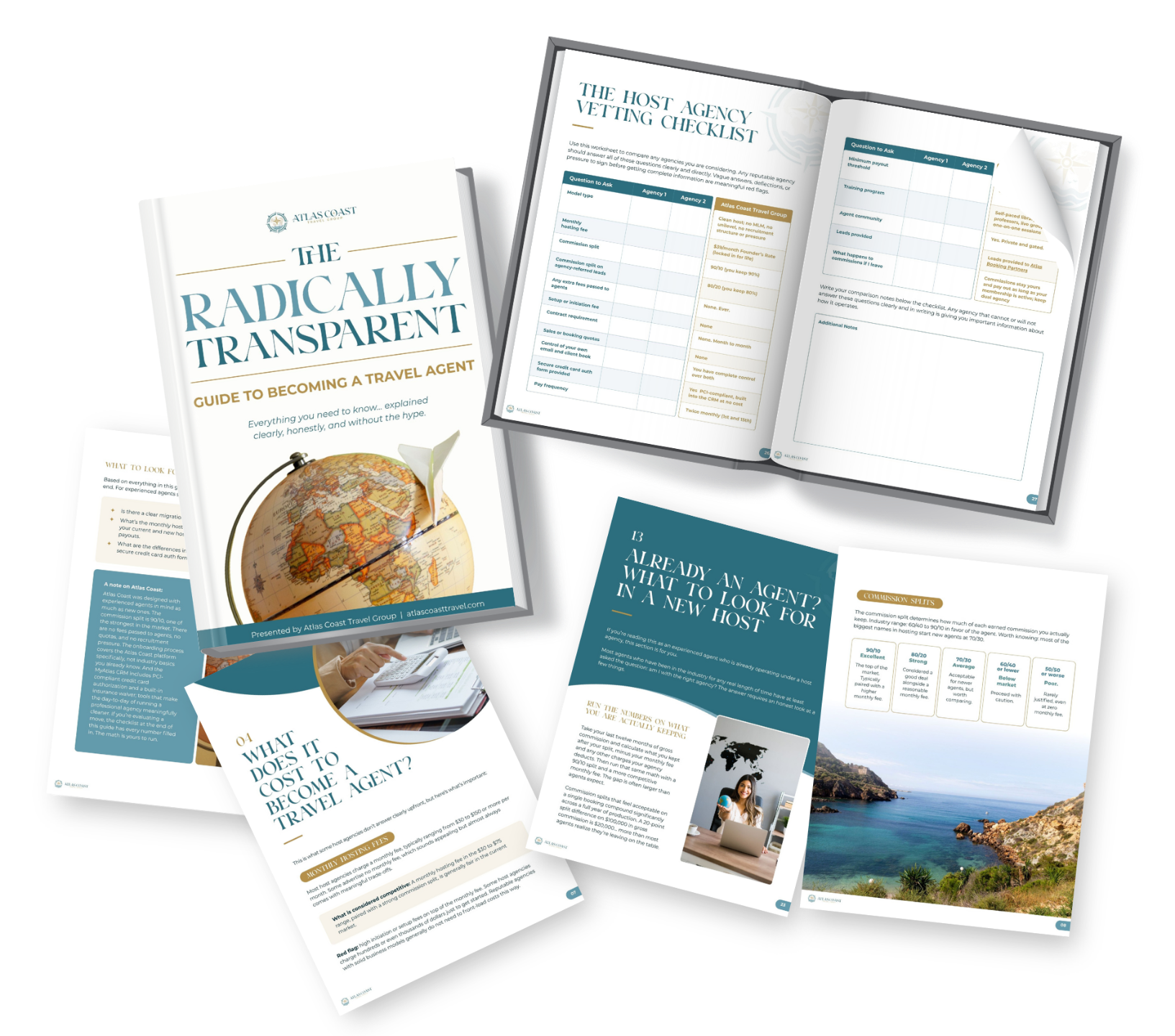
Atlas Coast is a non-MLM host agency built on radical transparency, with education-first onboarding through Atlas Academy. Start free: grab the Radically Transparent Guide to Becoming a Travel Agent, watch our free agent webinar to see exactly how it works, and join Atlas Coast when you're ready.
FAQ
Do you need a license to be a travel agent in the United States?
There's no federal license requirement. But four states have Seller of Travel registration rules: California, Florida, Hawaii, and Washington. If you or your clients are in those states, you'll need to follow them, and your host agency can help you figure out what applies to you.
How much does it cost to become a travel agent?
According to industry data from Travel Planners International (HAR, 2025), a basic setup runs about $1,500 to $3,000, and a more complete launch runs $3,000 to $7,000. After that, plan on $200 to $1,000 a month depending on your host agency fees, CRM, and how much you spend on marketing.
How long does it take to become a travel agent?
You can technically start booking within a few weeks of joining a host agency, once you've finished basic training and have your supplier portal access. Building a business that brings in real income usually takes two to three years of steady effort.
Do you need to have traveled extensively to be a travel agent?
No, but it helps, especially in the niche you focus on. First-hand experience with what you sell makes your advice more useful and more believable. Once you're established, supplier FAM trips are a great way to build that experience.
Can I be a travel agent while keeping my full-time job?
Yes, and for most new agents it's the smart way to start. Commissions are delayed and a client base takes time to build, so plenty of full-time agents began part-time and went all in once the income justified it.
What's the difference between a travel agent and a travel advisor?
They're used interchangeably. "Travel advisor" has caught on because it reflects how consultative the work really is, but it's the same job.
Sources: Travel Planners International startup cost breakdown (Host Agency Reviews, 2025); CLIA agent training standards; ASTA professional development guidelines; Host Agency Reviews income data.
Want to know all the info about becoming a travel agent?