What Is a Host Agency and Why Do Travel Agents Need One?

- Starting from the beginning
- What a host agency does for you
- What you give up to the host agency
- The accreditation problem and how hosts solve it
- Commission access: why the host agency model pays more than going it alone
- The three host agency models you will encounter
- What to look for when evaluating host agencies
- The questions most people forget to ask
- FAQ
Starting from the Beginning
If you want to be an independent travel agent, you hit a foundational problem on day one: you can't book anything without industry accreditation, and you can't get accreditation without booking volume.
This isn't a gatekeeping scheme. It's just how the travel supplier distribution system works. Cruise lines, tour operators, and hotel consortia require their distribution partners to meet minimum standards before granting commission access, and those standards include financial requirements, booking-volume thresholds, and professional training that a brand-new agent starting from scratch can't meet yet.
A host agency solves that entirely. Affiliate with a host and you plug into an existing accreditation structure with established supplier relationships, so you can start booking right away.
But choosing the right host is one of the most important decisions you'll make in your travel career. Here's everything you need to make it well.
What a Host Agency Does for You
Provides the accreditation number you need to book. Your host holds the CLIA, IATAN, or ARC accreditation that identifies you as a professional travel seller to suppliers. When you log into a cruise line's agent portal or a hotel's trade program, you're doing it under the host's credentials. That's what makes your bookings commissionable.
Gives you access to negotiated commission rates. A host with real booking volume has negotiated commission tiers with major suppliers that an individual agent can't get alone. A solo agent calling a cruise line directly gets the standard new-agency rate. An agent affiliated with a high-volume host gets the rate that the host's entire agent base has earned through combined production.
Processes your commissions. When a supplier pays commission on a completed booking, it goes to the host, which reconciles it against your booking records and pays out your share. It sounds purely administrative, and it is, but commission tracking and reconciliation is genuinely complex, and a host with real systems for it protects you against missing payments.
Provides technology and booking tools. Most hosts include CRM systems, booking platforms, marketing tools, and supplier portals that cost a lot more to access on your own. Quality varies a lot between hosts, but at a minimum you should expect the supplier portals you need to book.
Handles the back-office legal and financial infrastructure. Errors and omissions coverage (for hosts that carry it), client payment processing, supplier invoicing, and the compliance that comes with being a licensed travel seller. None of it is glamorous, but it matters enormously when something goes wrong.
Provides training and support. The range here is enormous. Some hosts offer real training curricula, mentorship, group calls, and dedicated support. Others give you next to nothing and leave you on your own. That gap in support is one of the biggest factors in whether an agent makes it, especially in the first two years.
What You Give Up to the Host Agency
A commission split. The host takes a percentage of your earned commissions in exchange for everything above. Common splits run from 70/30 to 90/10, with the bigger number being your share.
At the low end (70/30), the host takes 30 cents of every dollar you earn. At the high end (90/10), 10 cents. That difference compounds at scale, and we break it all down in why the 90/10 split matters.
Some hosts also charge monthly or annual fees on top of the split. Others charge fees only, with 100 percent commission to the agent. Others charge a split with no separate fee. Your total cost of affiliating is the combination, so run the math on your expected volume to see which structure actually wins. Here's every fee broken down.
You also give up some operational independence. Under a host's umbrella you operate within their policies, use their accreditation, and represent their professional standards. If you want a fully independent agency with your own supplier contracts, you eventually have to build the volume for your own accreditation, which is a later-stage move for high-volume agents.
The Accreditation Problem and How Hosts Solve It
To get why host agencies exist, you need to know what accreditation actually requires.
CLIA Travel Agency Membership (the most relevant credential for cruise-focused agents) requires a minimum annual booking volume in cruise commissions, a business bank account, a physical or virtual business address, errors and omissions insurance, and a completed application with supporting documentation.
IATAN accreditation asks for even more: a retail travel agency presence or equivalent, a minimum annual gross sales volume, and additional financial and professional requirements.
None of these are impossible, but they take time to reach. In the meantime, you still need a way to book commissionable travel, and the host agency model solves it by letting you operate under their existing credentials while you build toward your own.
Commission Access: Why the Host Agency Model Pays More Than Going It Alone
Here's the math that makes a host worth the split.
A cruise line sets commission tiers based on annual gross sales. An agency selling $1 million a year in cruise revenue earns a different base commission than one selling $100,000. The gap can be several percentage points, which on big bookings is hundreds of dollars per transaction.
A new solo agent has $0 in cruise sales history, so they're at the lowest tier available.
A new agent affiliated with a major host steps into the host's established tier on day one. If that host has earned elevated commission status with a cruise line, every agent under that umbrella books at the elevated rate.
The math favors the host model even after the split. Earning 90 percent of an elevated commission rate frequently beats earning 100 percent of a lower rate as a solo agent.
The Three Host Agency Models You'll Encounter
Traditional host agency. Monthly or annual fees, a commission split, a full-service support structure. Most hosts fall here, and quality varies enormously.
Franchise model. You operate under the franchisor's brand. More structure, a bigger upfront investment, more operational support. Examples include Dream Vacations and Cruise Planners. Good for people who want a turnkey business under an established brand.
Technology-platform model. Minimal fees, a high split (sometimes 100 percent), but also minimal support. You get accreditation and portal access, and training is largely self-directed. Good for experienced agents who don't need hand-holding and want to keep overhead low.
Most new agents are best served by the traditional model with a strong training and support component. The platform-only model fits experienced agents converting from another agency with an existing book of business.
What to Look For When Evaluating Host Agencies
Training quality. What does onboarding actually cover? Is it a structured program or a pile of documents? Is live support available? Especially in year one, training quality directly affects your ability to book correctly and dodge costly mistakes.
Commission split and fee structure. Run the real math on your expected volume. An 80/20 split with no monthly fee can be better or worse than a 90/10 split with a $50 fee, depending on how much you book.
Supplier relationships. Which suppliers does this host have elevated commission relationships with? If you'll specialize in cruises, are the cruise relationships strong? If you focus on tours, do they hold preferred tour-operator agreements? (Not sure where to specialize yet? Here's how to choose a niche.)
Transparency about their own terms. Will they show you the agent agreement before you pay anything? A host that won't is making a choice about what they want you to know. A host that publishes everything is telling you how it operates. Our contract guide covers exactly what to read.
Payment schedule and reliability. How often do commissions pay out? What's the process if one goes missing? How responsive is their accounting team? These sound boring until you're waiting on a commission that's covering your rent.
Community and peer support. Is there an active agent community? Do experienced agents help newer ones? Loneliness and confusion in the first 90 days is the number one driver of new-agent churn, so a strong community isn't a nice-to-have.
The Questions Most People Forget to Ask
- What happens to my client relationships if I leave? Do I keep my clients and their booking history?
- What happens to my earned-but-unpaid commissions if I cancel?
- Is there a cancellation fee or minimum commitment period?
- Who owns the client data I bring in or build through the host's systems?
- What's the process if I have a dispute with the host?
They feel presumptuous to ask upfront, but they're exactly the answers you need before you commit. Any host that reacts badly to being asked is telling you how it handles uncomfortable realities.
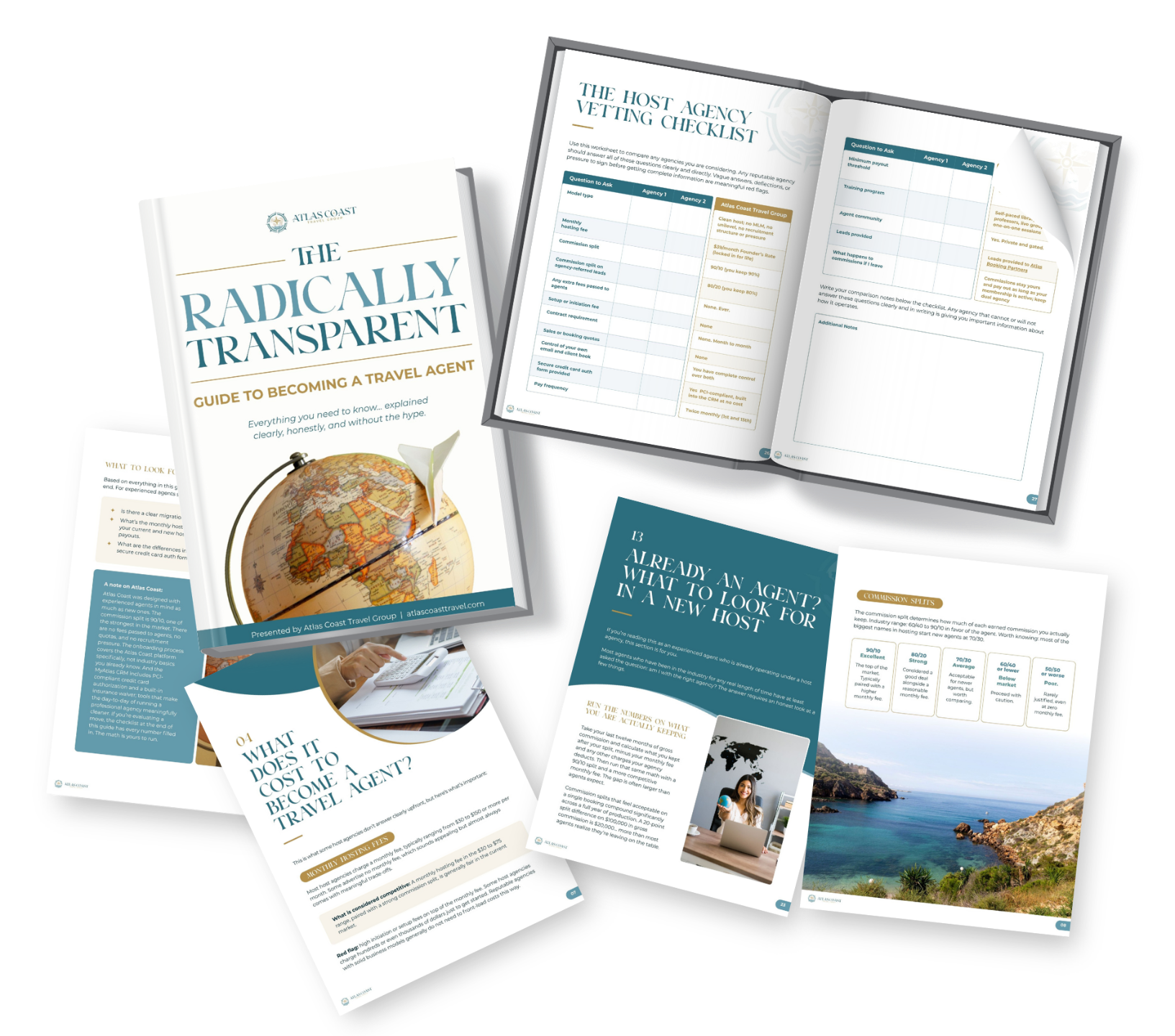
Atlas Coast publishes our full Independent Travel Agent agreement, our commission structure (90/10 standard, 80/20 on agency-generated leads), our fee ($49 a month), our pay schedule (the 1st and 15th), and what happens to your data and commissions if you leave. It's all out before you spend a dollar or hand over any personal information, and we're one of the only hosts in the country that works this way, because you should know what you're signing before you sign it. See it on the Why Atlas page, grab the free guide, watch the free agent webinar, and join Atlas Coast when you're ready.
FAQ
Do I need a host agency to sell travel?
You need either a host agency affiliation or your own direct accreditation to book commissionable travel professionally. A host is the practical path for most new agents, because direct accreditation means hitting volume and financial requirements that take time to reach.
What's a fair commission split with a host agency?
Anything from 70/30 to 90/10 is within the range the industry offers. What's fair depends on what you get in return. A host at 80/20 with excellent training, strong supplier relationships, and an active community can be better overall value than one at 90/10 with no support.
Can I be with more than one host agency?
Some hosts allow it and some prohibit it in their agent agreements, so read the contract. If it bars dual affiliation, respect that or risk termination. If it allows it, working under two hosts at once is uncommon but sometimes done by agents with very specific supplier needs.
How do I switch host agencies?
Check your current agreement for notice requirements and any minimum commitment. Export whatever client data you own under the agreement terms. Start your application with the new host and confirm the transition timeline. Your client relationships are portable as long as the agreement doesn't restrict client solicitation.
What's the difference between a host agency fee and a commission split?
A fee is a flat charge for affiliation, usually monthly or annual. A split is the percentage of earned commissions that goes to the host. Some charge both, some charge fees only with a 100 percent split, some charge a split with no fee. Total each model against your expected volume.
Sources: Host Agency Reviews top benefits of host agencies; CLIA accreditation standards; ASTA host agency guidelines; Host Agency Reviews commission structure comparison data.
Want to know all the info about becoming a travel agent?