A Travel Agent Asked You to Pay With Cash App? Here's Why That's a Red Flag

Picture this: you've been counting down the days, your bags are packed, and you pull up to the cruise terminal ready to sail. Then the check-in agent can't find your name. There's no cabin and no reservation, and the "travel agent" who took your money has stopped answering.
It's happening to real travelers right now. Fake travel agents find people on social media, offer deals that look amazing, and ask for payment through apps like Cash App. By the time the traveler finds out, the money's long gone.
At Atlas Coast Travel Group, we support thousands of independent travel agents, and we want every traveler to know how to tell a real agent from a scammer. Here's what to watch for, the one step you should never skip, and how to make sure your money goes where it should.
How the Travel Agent Cash App Scam Works
The setup is usually simple. Someone posts a great deal on a cruise, resort or vacation package on Facebook or in a travel group. You message them, they send you something that looks official, and they ask you to pay them instead of paying the travel company.
In one reported case, two Florida women made regular Cash App payments for a $523 cruise to someone they believed was a reputable travel agent. The "agent" was a scammer, and no reservation ever existed. In another, a couple paid the full cruise cost over time and even received a confirmation number and documents before the person disappeared.
Some cases are even bigger. In New York, an alleged scammer took thousands of dollars from travelers for a Royal Caribbean cruise and never made the bookings. The travelers only found out when they arrived at the cruise terminal in Bayonne, New Jersey.
The common thread? The money went to a person instead of to the travel company, and nobody checked the booking until it was too late.
Where Your Money Should Go When You Book With a Travel Agent
Here's what most travelers don't know: when you book through a legitimate travel agent, your payment goes to the supplier. That's the company actually providing your trip, like the cruise line, resort, tour operator, airline or rental car company. It doesn't go to the agent. The supplier pays the agent a commission later, which is why using a good travel agent usually doesn't cost you extra for the trip itself. (Here's more on whether travel agents cost extra.)
At Atlas Coast Travel Group, our agents never take payment directly. Your card details are collected through a secure, PCI-compliant form (PCI is the security standard for handling credit card data), and your payment goes to the supplier. That protects you, and it protects your agent too.
So when someone asks you to pay them, in any form, that's your cue to stop.
It's Not Just Cash App
Cash App gets the headlines, but the payment method is the warning sign, not the app. Be just as careful if a "travel agent" asks you to pay with:
- Zelle, Venmo or PayPal Friends and Family
- A wire transfer or bank transfer to a person or business
- A personal check, cash or a money order
- Gift cards or cryptocurrency
- A payment link or invoice from Square, Stripe, PayPal or any other card processor that bills you in the agent's name or the agent's business name
- Your card number sent by text, email or DM, so they can "run it for you"
That Square and Stripe one catches a lot of people, because it feels safe. You're paying with a credit card, you get a receipt, and it looks professional. But the money lands in the agent's account, not the supplier's. From there, you're trusting that person to pass your money along, and that's exactly the gap scammers use.
The Step You Can't Skip: Look Up Your Booking Yourself
If you take only one thing from this post, make it this one. Don't rely on a confirmation someone sends you. Documents and confirmation numbers can be faked in minutes. Check the booking yourself, directly with the supplier.
Every real reservation has a booking number from the supplier, even when a travel agent made it. Most cruise lines, resorts and airlines let you look up a reservation on their website or app with that number. Make sure your name, date of birth and travel dates are correct. If you can't find it, call the supplier using the phone number on their official website, not a number from a search ad or from the agent.
Here's the catch, though: a booking that shows up isn't proof everything's fine. Scammers have other tricks:
- The unpaid hold. Some travel companies let agents hold a cabin or room for a short time without paying. The booking number is real, but if nothing's paid, it disappears when the hold expires.
- The stolen card booking. A scammer takes your money, then books your trip with a stolen credit card. Your booking looks perfect until the real cardholder disputes the charge and the supplier cancels your reservation, sometimes right before you travel.
- The partial payment. You paid in full, but only a deposit ever reached the supplier.
That's why looking up your booking is just the first check. When you look it up, confirm these three things:
- Your booking is there, under your name, with the right dates.
- The amount paid matches what you paid. If the booking shows a deposit or a zero balance paid and you sent the full amount, something's wrong.
- The charge on your own card statement is "paid to" the supplier. More on this one next.
The "Paid To" on Your Card Statement Has to Be the Supplier
This is non-negotiable. Once you've paid, open your credit card statement or banking app and find the charge. The merchant name on it has to be the supplier providing your trip, like the cruise line, the resort, the tour operator or the airline, and the amount has to match your invoice.
If you booked a vacation package through a tour operator, the charge may show the tour operator's name instead of the resort's. That's normal, because the tour operator is the supplier on that booking. The charge should match the company named on your invoice or confirmation.
If the charge shows the agent's name, the agent's business, a Square or Stripe payment, or any company that isn't your supplier, stop and call the supplier directly. And if your booking shows as paid but there's no matching charge from the supplier on your card at all, someone else's card may have paid for it. Call the supplier right away.
7 Red Flags of a Fake Travel Agent
Watch for these warning signs before you hand over a single dollar:
- They want payment sent to them, through an app, a transfer, a Square or Stripe link, or their own invoice.
- The deal seems too good to be true. Huge discounts and "buy one, get one" offers are classic bait.
- They pressure you to pay fast. "Only two cabins left at this price!" is meant to stop you from checking.
- They found you on social media. A random message or a comment on a post isn't how most real agents start working with you.
- They can't give you a booking number you can look up with the supplier.
- They won't say which agency they work with. Independent agents usually work under a host agency with its own accreditations, like CLIA (Cruise Lines International Association) and IATA or IATAN numbers. Look the agency up yourself.
- They get vague when you ask for documentation. A real agent is glad to show you exactly what was booked and paid, every step of the way.
For a deeper checklist, here's how to tell if a travel agent is legitimate.
What to Do If You Think You've Been Scammed
Act fast. Call the supplier to find out whether a booking exists and what's been paid on it. Contact your bank or card company, and report the payment to the app or processor you used. Then file a report with the FTC at ReportFraud.ftc.gov and with your local police. The sooner you report it, the better the chance of stopping the scammer from targeting someone else.
The Bottom Line: Real Agents Make Travel Safer
These scams can make people nervous about using a travel agent at all, and we get that. But a legitimate agent is one of the best protections you've got. They know the suppliers, they spot problems before you travel, and they're there when plans change. That's just one of the perks of using a travel agent, and if you've ever wondered what a travel agent actually does, it's a lot more than booking.
The key is working with a real agent who books through a real agency, and checking the work. Pay the supplier, never the person. Look up your booking yourself. Make sure the amount paid matches and the "paid to" on your card statement is the supplier. Do those things and you've shut the door on most of these scams, so you can enjoy everything a good agent brings, especially on the trips where a travel agent is worth it. Still deciding? Here's how using a travel agent compares to booking yourself.
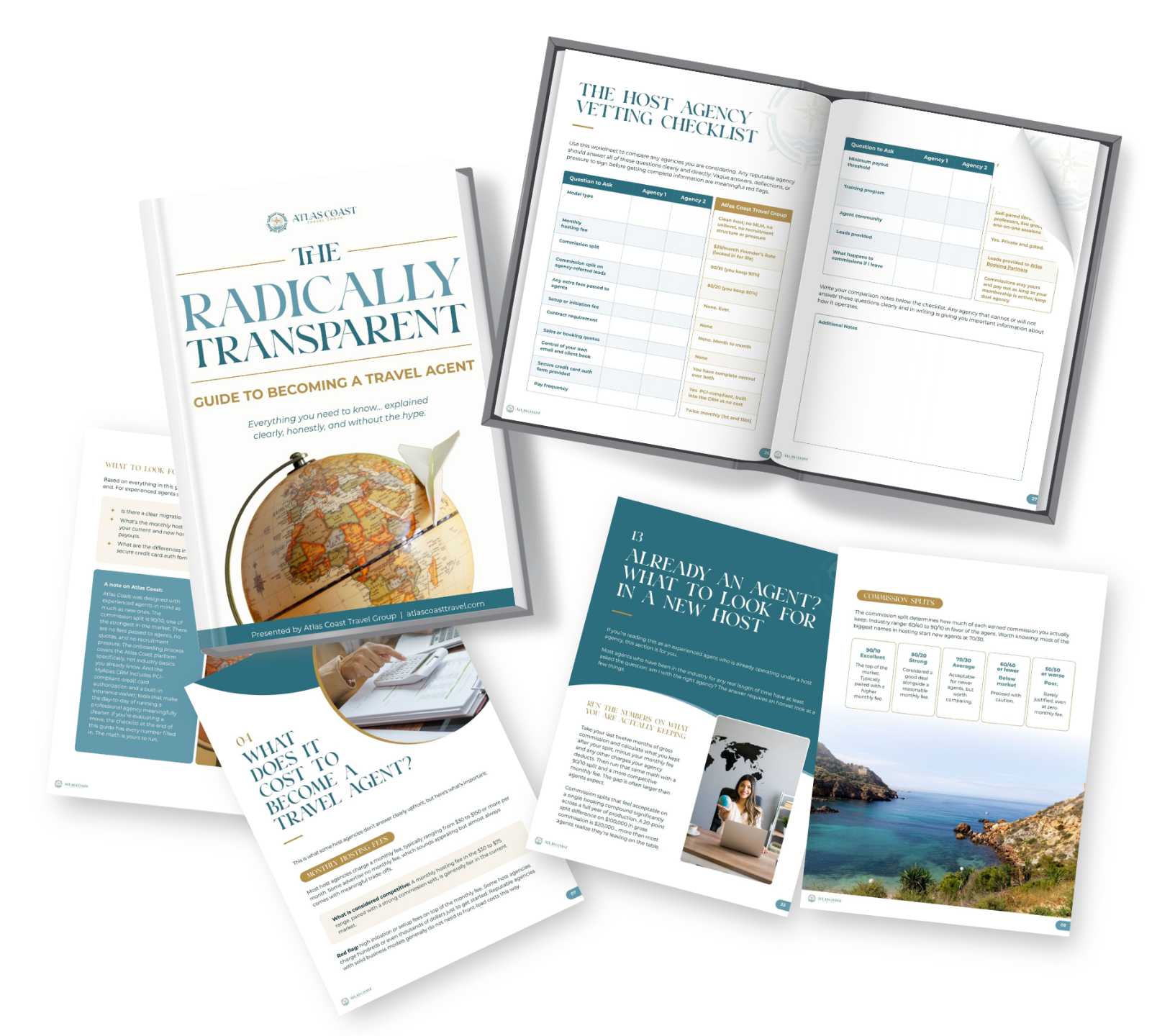
If you're the friend everyone asks for travel advice, you might make a great travel agent yourself. Atlas Coast is the no-pressure host agency for independent travel agents, with no quotas, no MLM recruiting and no tiers to climb. Start with the free Radically Transparent Guide to Becoming a Travel Agent or save a seat at the free webinar on becoming a travel agent. Planning a trip instead? You can submit a trip request to be matched with an Atlas Coast advisor.
FAQ
Do real travel agents accept Cash App?
No. Your payment should go to the supplier, like the cruise line, resort or tour operator. A request to pay an agent through Cash App, Zelle, Venmo or any other method is a major red flag. Want to see what a legitimate agent does for you instead? Here are the perks of using a travel agent.
Is it safe if my travel agent sends me a Square or Stripe payment link?
Not for your trip. A Square or Stripe link puts your money in the agent's account, not the supplier's. The charge for your trip should come from the supplier.
How can I check if my booking is real?
Look it up yourself on the supplier's website or app, or call the supplier using the phone number on its official site. Confirm your name and dates, check that the amount paid matches what you paid, and make sure the "paid to" on your card statement is the supplier.
Can a booking be real and still be a scam?
Yes. A scammer might put your trip on an unpaid hold, pay only a deposit, or book it with a stolen credit card that gets disputed later. That's why you should check the amount paid and your own card statement, not just whether the booking exists.
What should I do if a fake travel agent took my money?
Contact the supplier, your bank or card company, and the payment app or processor right away, then report it to the FTC and your local police.
Sources: reporting on cruise booking scams from Cruise Hive and Cruise News Today via AOL; booking verification guidance from AARP; FTC fraud reporting.
Atlas Coast Ventures LLC dba Atlas Coast Travel Group | Fla. Seller of Travel Reg. No. ST46588 | Washington UBI No. 606214170-001-0001 | California CST 2172267-70 | Hawaii TAR-7632-0
Registration as a seller of travel does not constitute approval by the State of California.
Want to know all the info about becoming a travel agent?