What's a Host Agency? A Consumer Guide

The Term Nobody Explains
If you've ever worked with an independent travel agent, you may have noticed their business card has two names on it: their own name and their agency name, plus sometimes a third that's their "host agency." Or their email comes from one domain but they introduce themselves as a different company entirely.
It confuses people, understandably. Nobody in the industry takes five minutes to explain it in plain language, which is frustrating, because the structure really isn't complicated.
Here's the plain-language version.
What a Host Agency Actually Is
A host agency is an umbrella organization that independent travel agents affiliate with. It provides the accreditation, supplier relationships, technology systems, commission processing, and professional infrastructure individual agents need to operate legitimately.
Think of it like a general contractor and subcontractor. The host agency is the licensed general contractor with the bonding, the established supplier relationships, and the industry standing. The independent agent is the skilled professional who does the client-facing work under that umbrella. (Here's what a travel agent actually does day to day.)
The independent agent isn't an employee of the host. They're an independent contractor who uses the host's accreditation number to process bookings, access supplier systems, and receive commissions.
So when your travel agent says they're "with" a particular host agency, they're telling you who their professional infrastructure provider is.
Why This Structure Exists
Industry accreditations like CLIA membership and IATAN credentials have minimum requirements around booking volume, financial standing, and professional standards. A brand-new independent agent doesn't have the volume to qualify for those on their own.
A host agency aggregates the volume of all its affiliated agents. When a cruise line looks at the host, they see one large agency with combined sales across hundreds or thousands of agents. That combined volume qualifies for better commission rates, better access, and stronger relationships with supplier reps than any individual agent could build alone.
From your perspective as a traveler, that means your independent agent has access to the same supplier relationships and commission tiers as a major travel agency, not just the terms a lone new agent would get walking in the door.
What It Means for You as a Traveler
Better commission access. Because your agent operates under the host's accreditation and volume, they can reach commission tiers and promotions that wouldn't be available to a truly solo agent with no buying power. (Here's how agent commissions work and why they don't cost you extra.)
A layer of accountability. If you have a problem with your agent, the host is accountable too. A host with professional standards has policies for how agents must handle client situations, and mechanisms to address complaints that go beyond what an individual could offer.
Verified industry standing. A host with CLIA membership and ASTA affiliation has met real requirements, and its agents operate under accreditation you can independently verify. That's meaningfully different from someone who just printed a business card. (Here's how to verify an agent before you pay.)
Commission processing infrastructure. When your trip ends and the supplier pays the commission, it flows through the host's accounting systems, which reconcile what was earned against what was paid. An agent without that infrastructure has a much harder time catching and fixing commission discrepancies.
Host Agency vs. Travel Franchise vs. Independent Agency
Host agency: the agent is an independent contractor who keeps their own brand. They affiliate with the host for accreditation and infrastructure, and the host takes a percentage of commissions in exchange.
Travel franchise: the agent operates under the franchisor's brand and system. Think Dream Vacations or Cruise Planners. More structure, less flexibility, usually a larger upfront investment.
Independent accredited agency: the agency holds its own IATAN or CLIA accreditation, maintains its own supplier contracts, and doesn't affiliate with a host. That takes significant booking volume and operational infrastructure to justify.
For most new-to-mid-level independent agents, the host model makes the most sense. It provides the professional infrastructure without requiring the volume needed for direct accreditation.
What to Look For in a Host Agency
If you care about the quality of the agent you're working with, the host they affiliate with is a reasonable thing to evaluate. Here's what to look at:
Published transparency. Does the host explain how they operate, what their commission splits look like, and what their agent agreement contains? Or is it all gated behind a sales call? A host that won't show you the terms before you commit is making a choice about what they want you to know, and that choice tells you something.
Industry memberships. CLIA, ASTA, and Travel Leaders Network membership all signal professional standing. Look them up. Verify they're current.
Training requirements for agents. Does the host require agents to complete training before working with clients? What does it cover? A host that lets untrained agents book clients immediately is putting client experiences at risk.
Longevity and reputation. How long has the host been operating? Are there verifiable reviews from agents who work with them? Host Agency Reviews maintains one of the most comprehensive databases of host agency data and agent reviews in the industry.
How commissions are paid. What's the schedule? How are disputes handled? What happens if a commission goes missing? These operational questions tell you whether the host's systems actually function.
The Accountability Question
Here's the thing about the host agency structure that matters most for travelers: accountability is shared.
When you book with an independent agent affiliated with a legitimate, professionally credentialed host, you have two layers of accountability. The agent is accountable to you directly. The host is accountable for the agent's conduct and can remove agents who don't meet its standards.
An agent operating with no host, no verifiable accreditation, and no professional infrastructure has no accountability layer beyond themselves. If something goes wrong, your options are narrower.
That's not a theoretical concern. There are real situations where clients need to escalate beyond their agent, and having a host with real standards makes a real difference in how those resolve.
Atlas Coast Travel Group is a host agency. Our independent advisors are trained through Atlas Academy, hold CLIA credentials under our agency membership (CLIA ID 00810443), and operate under an agent agreement we publish openly, not gated behind a sales call. If you'd like to work with one of our advisors, here's why working with a travel agent is worth it, and you can submit a trip request to be matched with the right one.
FAQ
Why does my travel agent say they're "with" a host agency?
It means they're an independent contractor affiliated with the host for accreditation, supplier access, and commission processing. They use the host's industry credentials to operate professionally while keeping their own client relationships and, often, their own brand.
Does the host agency have access to my personal information?
Yes. Because the host processes commissions and keeps booking records, they have access to booking-level information, including names and travel details tied to your reservation. They should have a published privacy policy explaining how that information is handled.
Can I complain to the host agency if I have a problem with my agent?
You can, and for serious issues you should. A host with professional standards has mechanisms to address agent conduct complaints. The agent agreement typically spells out the standards the agent must meet and the grounds for removal from the program.
Is a host agency the same as a travel agency?
They're different structures. A travel agency typically employs its own agents and operates under its own accreditation. A host agency provides infrastructure to independent contractors who keep their own client relationships. The consumer experience can feel similar, but the employment and accountability structures differ.
Why do some travel agents not work with a host agency?
Agents with enough booking volume can get their own direct IATAN or CLIA accreditation and operate fully independently. That makes sense for high-volume agencies that want direct supplier contracts and keep their entire commission. For most independent agents, especially newer ones, the host model makes more sense financially and logistically.
How does the host agency make money?
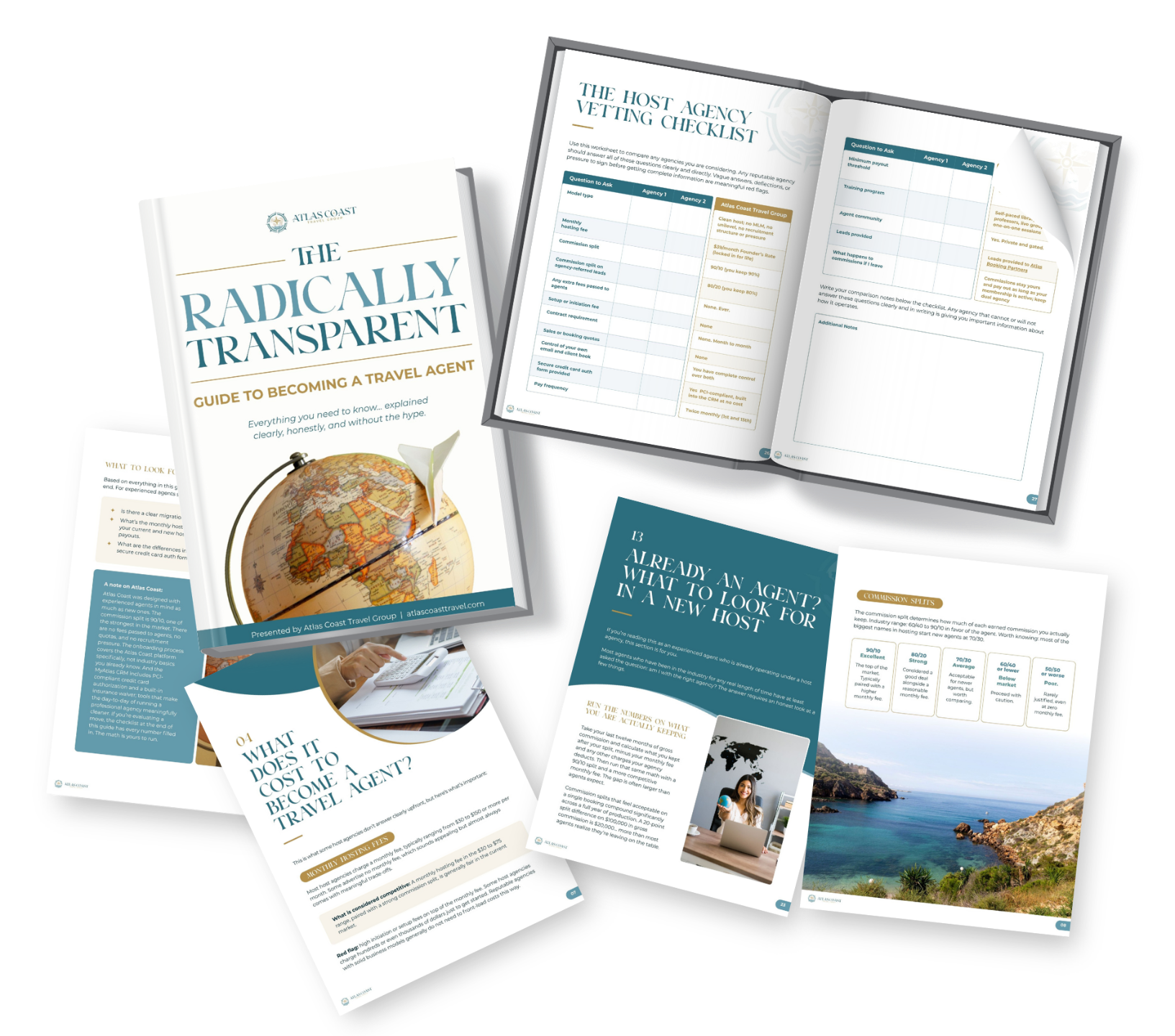
The host takes a percentage of the commissions its affiliated agents earn, called a commission split. Common splits run from 70/30 to 90/10, with the larger number being the agent's share. The host's portion covers accreditation, technology, support, and the supplier relationships that make higher commissions possible.
Sources: Host Agency Reviews; CLIA agency accreditation standards; ASTA membership requirements.
Want to know all the info about becoming a travel agent?