Should Travel Agents Charge Planning Fees?

- Why this question does not have a simple answer
- What a planning fee is and is not
- The case for charging fees
- The case against charging fees
- When planning fees make the most sense
- When planning fees hurt more than they help
- How to structure a fee if you decide to charge one
- The legal exception you cannot ignore
- The lead referral exception
- FAQ
Why This Question Doesn't Have a Simple Answer
I've heard travel agents argue both sides of this with religious conviction. Some say you're devaluing your work if you don't charge fees. Others say fees are a conversion killer that costs them clients. Both groups have evidence.
The honest answer is that the right policy depends on your niche, your client type, your booking complexity, and your stage of business. So instead of a blanket rule that ignores your situation, let's walk through the factors that should actually drive your decision.
What a Planning Fee Is and Is Not
A planning fee (sometimes called a service fee or consultation fee) is a charge you bill the client directly for your time, research, and expertise. It's separate from the commission you earn when they book.
It isn't a markup on the trip price. You're not quietly padding the supplier's rate and pocketing the difference. The fee is disclosed, named, and charged directly.
Common formats:
- Flat fee per booking or per itinerary ($50, $100, $150, $200)
- Tiered fees based on trip complexity (simple booking vs custom itinerary)
- An upfront consultation fee applied toward the booking if the client proceeds
- A non-refundable deposit for complex custom trip research
The Case for Charging Fees
Your time has real value. A custom two-week European itinerary with flights, hotels, private transfers, guided experiences, and restaurant reservations can be 10 to 20 hours of professional work. If the trip gets cancelled after all that, you earn nothing. A planning fee recovers at least part of that investment.
Fees filter out non-serious clients. The person who'll burn three hours of your time comparing every option, change their mind repeatedly, and then book on Expedia because it was $12 cheaper will rarely pay a fee. That client costs you time and money, and a fee screens them out upfront.
Fees change how clients perceive your value. When you don't charge for your time, some clients unconsciously read it as having no value. A professional who charges for their expertise is seen as having something worth paying for. That's a real psychological dynamic, not a theory.
Fees protect you when commissions are low or zero. If you book a complex air itinerary that earns almost nothing in commission, a service fee makes sure you're paid for the work regardless of how that product commissions.
The Case Against Charging Fees
Fees create conversion friction. Some potential clients won't call you if they know there's a fee, especially early on, before you have the reputation or referral network to justify premium pricing in their minds. For a new agent building volume, that friction can really matter.
The market isn't fully fee-normalized. Unlike lawyers or accountants, where everyone expects to pay for professional time, travel agents have historically run on commission only. Some clients still find a fee surprising or off-putting, especially on standard bookings. The perception is shifting as the industry evolves, but it hasn't shifted all the way.
Commission already pays for your time on completed bookings. When a booking closes and the client travels, you earn a commission, which is, in theory, your compensation for the work. The case for fees is strongest when that commission doesn't cover the work involved, or when bookings regularly don't close after heavy research.
When Planning Fees Make the Most Sense
Complex custom FIT itineraries. A 21-day, multi-country trip with internal flights, specific accommodation requests, private experiences, and detailed logistics is real research work that a single commission may not cover. A fee is justified.
Any booking where tire-kickers eat your time. If you're regularly spending hours with people who don't book, or who book elsewhere after using your research, a fee is a reasonable filter.
Air-heavy bookings where commissions are minimal. Complex international routing across multiple carriers can be a lot of work for trivial or zero commission. A service fee makes sure you're paid.
Clients with a history of changing their minds. If someone requested multiple revisions on a prior trip, a clearly stated revision-fee structure is completely appropriate.
When your reputation can carry the premium. The known destination-wedding specialist in a community charges from a position of recognized expertise. A brand-new agent with no track record charges from a position of asking clients to take a risk on an unproven vendor. Stage of career matters.
When Planning Fees Hurt More Than They Help
In the first 12 to 18 months of building your client base. Volume and relationships matter more than per-booking margin while you're building. A fee that costs you a client costs you a booking and a node in your referral network. Plenty of agents in the building phase choose to remove friction over squeezing per-booking revenue.
On standard, straightforward bookings. A family booking a mainstream cruise doesn't involve heavy custom research. A fee there is harder to justify and can create friction without matching value.
When the client is a referral from your best referral source. Use judgment. A high-value referral from your best client may not be the booking where you debut a fee.
How to Structure a Fee If You Decide to Charge One
Disclose it upfront, before any work begins. This isn't optional. The client has to know and agree to the fee before you start researching their trip. Surprise fees destroy trust faster than almost anything.
Put it in writing. Your client agreement or intake form should spell out the fee, the amount, what it covers, and whether it's refundable if the booking doesn't proceed.
Apply it toward the booking where you can. An approach that works well: charge a planning or consultation fee upfront, then credit it toward the total if the client books. It feels fair to clients, and it is fair.
Consider tiers. A simple $50 processing fee on standard bookings is a different thing from a $200 research fee on a complex custom itinerary. Tiers that match the fee to the work are more defensible than one flat fee on everything.
The Legal Exception You Cannot Ignore
Florida is the exception, and it's the law, not a policy.
If your client is a Florida resident, you cannot charge them a separate service or planning fee. This is Florida state law (Chapter 559, Florida Statutes), and it applies based on where the client lives, not where you're based. A California agent with a Florida client still can't charge that client a fee.
It's the kind of compliance detail that's easy to miss until it becomes a problem, so don't skip it. Other Seller of Travel states regulate how fees are handled too, so it's worth knowing the rules wherever your clients live. Here's how seller of travel laws work by state.
The Lead Referral Exception
If your host agency refers a client to you through a lead program, charging that client a planning fee makes you ineligible for future lead referrals. Your own clients and your own business: charge whatever makes sense. Clients who came through the lead program: no fee.
The reasoning is simple. The lead was generated by the host's marketing and audience, and the benefit of receiving it is the business itself. Adding a fee to a referred client's transaction affects the host's relationship with that prospect, and that's outside what lead-sharing is meant to do.
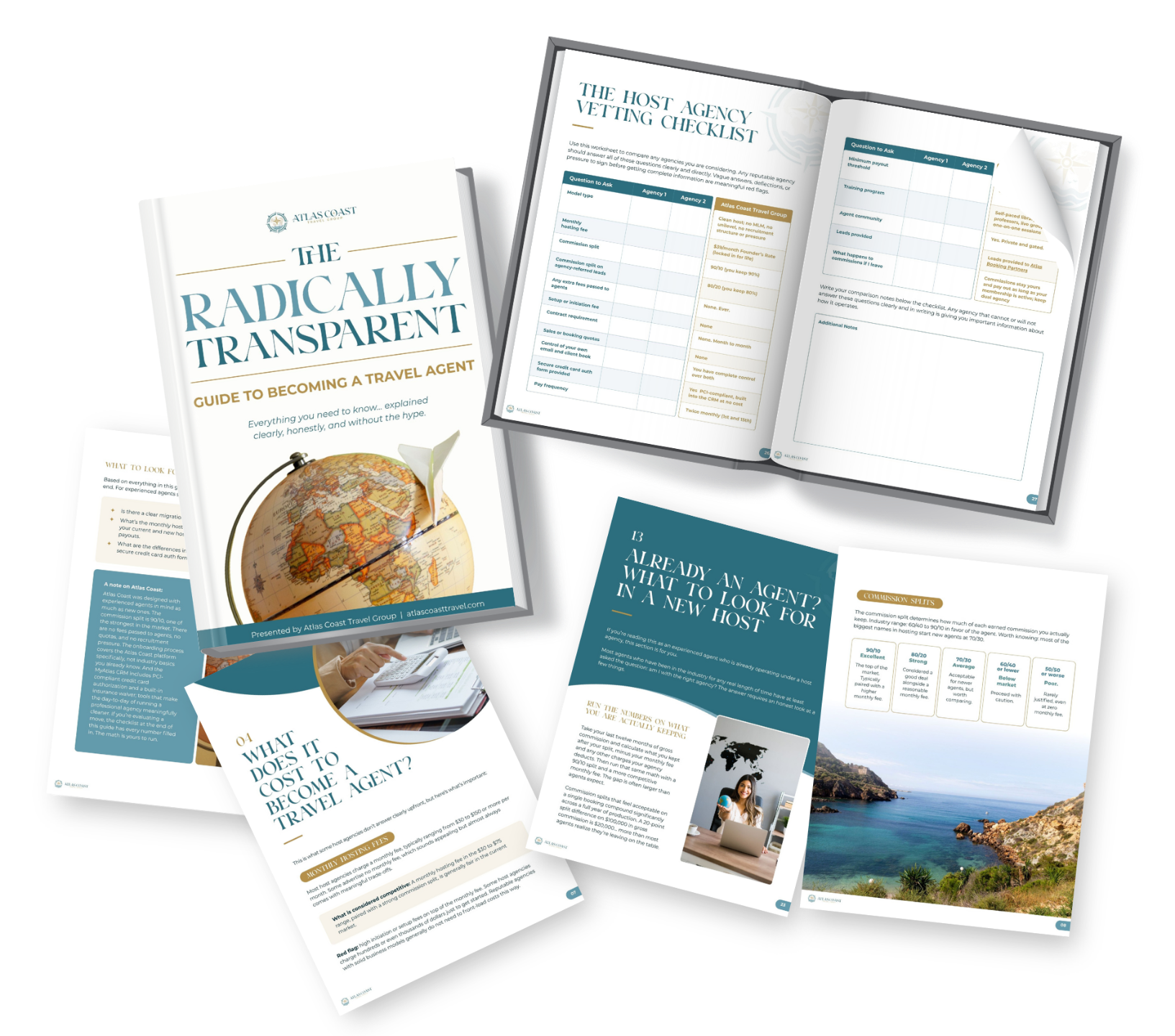
Atlas Academy walks through the whole planning-fee decision in detail, including language for disclosing a fee to clients, the Florida prohibition, the lead-referral rule, and how to handle it when clients push back. We'd rather you charge confidently and legally than guess. See how the training and support fit together on the Why Atlas page, grab the free guide, watch the free agent webinar, and join Atlas Coast when you're ready.
FAQ
What is a typical planning fee for a travel agent?
Common ranges are $50 to $200 for standard bookings, $150 to $500 for complex custom itineraries, and higher for destination weddings or honeymoons that involve serious coordination. There's no industry standard, and fees vary widely by agent, niche, and complexity.
Do planning fees affect client conversion rates?
Yes, and which way depends on your reputation, your client type, and how you position the fee. For well-established agents with strong reputations, fees rarely deter serious clients. For newer agents with less established credibility, fees can create friction that lowers conversion.
Can I charge a planning fee and still earn a commission?
Yes. Planning fees and commissions are separate revenue streams. You earn the commission from the supplier when the booking completes, and you collect the planning fee from the client for your time. Neither affects the other in most host agreements, but confirm it in your specific contract.
Should I charge a fee on every booking or only on complex ones?
Most agents who charge fees use complexity-based tiers. A flat fee on every booking, including simple ones, can feel arbitrary to clients. Fees scaled to complexity feel proportional and are easier to justify.
What should I do if a client refuses to pay a planning fee?
That's useful information. A client who won't pay a modest fee for your professional time is showing you how they value your work. You can waive it and proceed, which is sometimes the right call for the right client, or decline the booking, which is also sometimes the right call. The fee conversation is often the first boundary you set in a professional relationship.
Sources: Host Agency Reviews planning fee survey data; ASTA advisor compensation research; Florida Seller of Travel law (Chapter 559, F.S.).
Want to know all the info about becoming a travel agent?